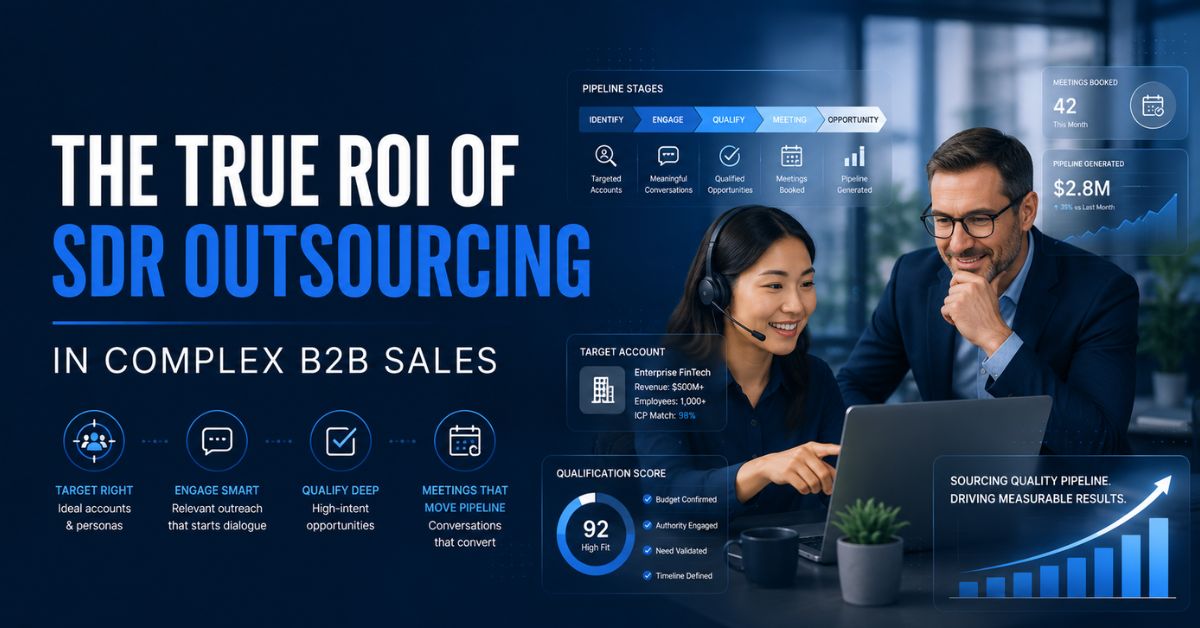
SDR Outsourcing is not just a cost-saving decision. Salaria Sales helps complex B2B teams turn outsourced sales development into better pipeline, stronger meetings, and measurable revenue growth.
Complex B2B sales require more than a large list of prospects and a few outbound sequences. Buyers are harder to reach, sales cycles are longer, and decision-making groups are often made up of multiple stakeholders. This is why many companies are rethinking how they measure the true value of SDR Outsourcing. The return on investment is not only about reducing hiring costs or adding more outreach activity. It is about improving pipeline quality, increasing sales team productivity, creating better-qualified meetings, and helping account executives focus on closing deals. In complex B2B sales, every weak meeting creates hidden costs, while every well-qualified opportunity can improve revenue efficiency. A modern SDR outsourcing model combines outbound sales development, B2B lead generation, targeted prospecting, and a Human-AI Sales Approach to create measurable business outcomes. In this article, we explore the true ROI of SDR Outsourcing and why it matters for companies selling complex solutions.
What Is SDR Outsourcing
SDR Outsourcing is the process of partnering with an external sales development team to manage prospecting, outreach, qualification, appointment setting, and early-stage pipeline creation. It helps businesses scale outbound sales development without building a full in-house SDR team from scratch.
1. SDR Outsourcing Supports the Front End of Revenue Growth
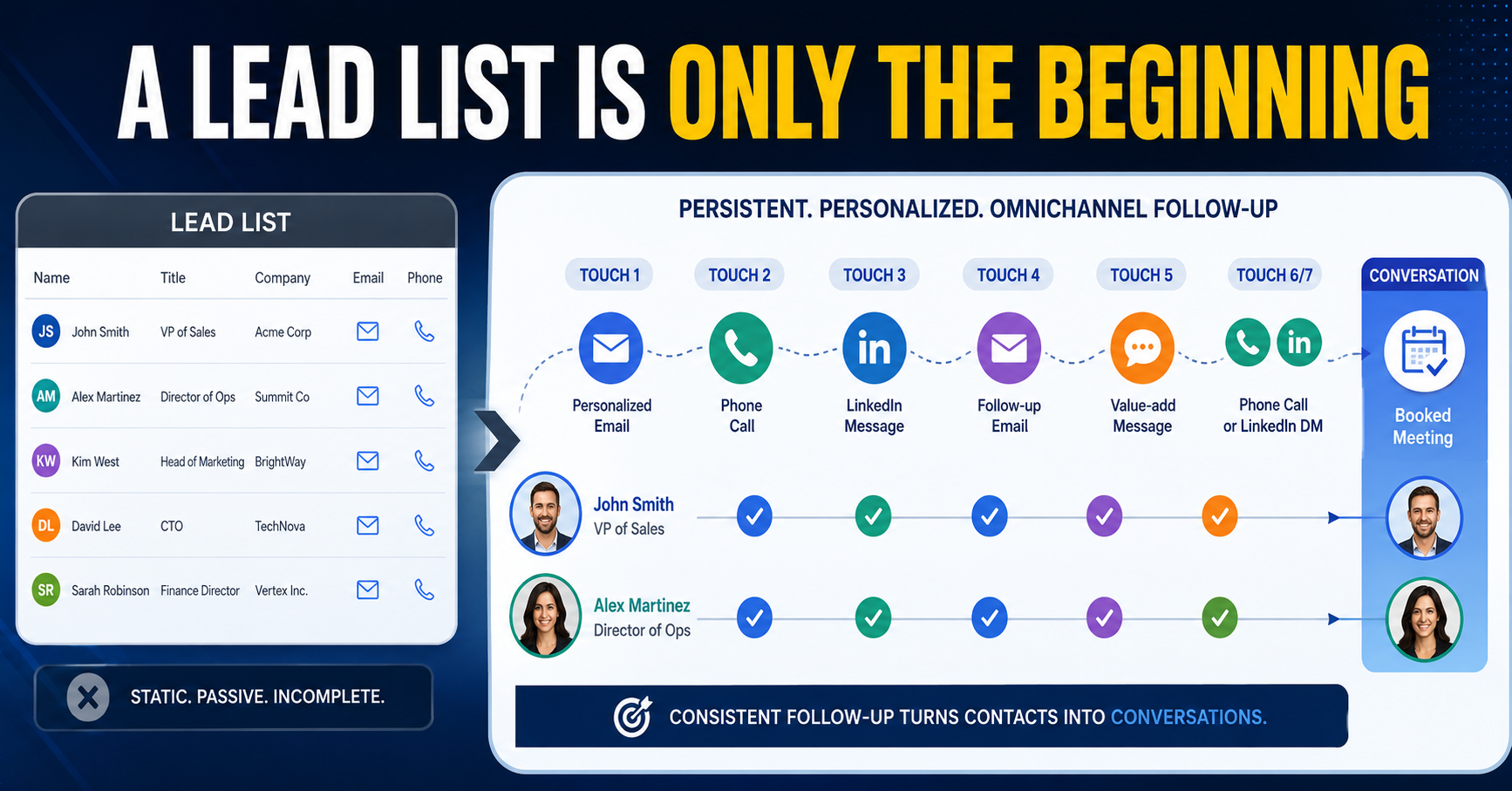
SDR Outsourcing focuses on the early stages of the sales process, where prospects are identified, engaged, qualified, and moved toward sales conversations. This includes researching target accounts, reaching out through email, cold calling, LinkedIn, and nurturing prospects until they are ready for a meeting. In complex B2B sales, this front-end work is essential because decision-makers are often busy, cautious, and difficult to reach. A strong outsourced SDR team helps create consistent outreach and keeps the pipeline active. When done correctly, SDR Outsourcing becomes a direct contributor to revenue growth rather than a simple support function.
2. SDR Outsourcing Helps Sales Teams Focus on Closing
Account executives are usually most valuable when they are handling discovery, proposals, negotiations, and closing conversations. When they spend too much time prospecting, researching contacts, writing outbound messages, or chasing unqualified leads, the business loses closing capacity. SDR Outsourcing allows closers to spend more time with qualified prospects who are already prepared for a meaningful conversation. This improves productivity and helps companies use their sales talent more efficiently. The true ROI comes from giving each role in the sales process the right focus.
3. SDR Outsourcing Is More Than Adding More Reps
A common mistake is viewing SDR Outsourcing as simply adding more people to make calls or send emails. In reality, effective outsourcing requires strategy, targeting, messaging, qualification, reporting, and continuous optimization. Without these elements, more activity may not produce better pipeline. The best SDR outsourcing programs are structured around business goals, buyer fit, and revenue outcomes. This makes outsourced SDR teams an extension of the sales organization, not just a vendor doing outreach.
4. SDR Outsourcing Works Best in Complex B2B Sales
Complex B2B sales often involve long buying cycles, multiple stakeholders, technical solutions, and high-value contracts. These conditions make strategic prospecting and qualification even more important. An outsourced SDR team can help identify the right accounts, engage decision-makers, and gather useful buyer context before the sales conversation begins. This improves the quality of meetings and reduces wasted time for the sales team. In complex sales environments, SDR Outsourcing delivers ROI by creating better opportunities, not just more opportunities.
What Does ROI Mean in SDR Outsourcing
The ROI of SDR Outsourcing should be measured by the business value created from outsourced sales development activity. This includes revenue contribution, pipeline quality, efficiency gains, cost savings, and improved sales team focus.
1. ROI Includes Pipeline Created
One of the clearest ways to measure SDR Outsourcing ROI is by evaluating the qualified pipeline created from outbound sales development. This means looking beyond the number of meetings booked and measuring how many of those meetings become real sales opportunities. A strong SDR partner should help generate pipeline that matches the Ideal Customer Profile and has realistic revenue potential. This makes the investment easier to connect to future revenue. Pipeline quality is often a stronger ROI indicator than lead volume.
2. ROI Includes Sales Team Efficiency
SDR Outsourcing also creates value by improving how internal sales teams spend their time. When account executives are not overloaded with prospecting tasks, they can focus on higher-value sales activities. This includes deeper discovery, stronger follow-up, better proposal work, and improved deal management. Sales efficiency matters because every hour spent on poor-fit outreach is an hour not spent on revenue-generating conversations. Outsourced SDR support can help reduce this inefficiency.
3. ROI Includes Lower Operational Costs
Building an internal SDR team involves recruiting, salaries, benefits, tools, training, management, and ongoing performance oversight. SDR Outsourcing can reduce some of these costs by giving businesses access to trained sales development resources and established processes. However, cost savings alone should not be the main measure of ROI. The stronger value comes from combining lower operational burden with improved outbound performance. A good outsourced SDR partner helps companies scale without taking on the full complexity of an internal buildout.
4. ROI Includes Faster Learning and Market Feedback
Outbound sales development creates valuable market intelligence. SDR teams learn which messages resonate, which objections appear most often, which buyer roles engage, and which segments produce better opportunities. In complex B2B sales, these insights can influence sales strategy, positioning, and go-to-market planning. SDR Outsourcing can accelerate this learning because a dedicated team is consistently speaking with the market. The ROI includes not only meetings booked but also the intelligence gained from real buyer conversations.
Why SDR Outsourcing ROI Matters in Complex B2B Sales
Complex B2B sales require careful investment because customer acquisition costs can be high and sales cycles can be long. Measuring SDR Outsourcing ROI helps companies understand whether outbound sales development is producing meaningful value.
1. Complex Sales Require Better Qualification
In simple sales environments, a high number of meetings may be enough to create momentum. In complex B2B sales, weak meetings can create significant waste. Account executives may spend hours on discovery calls, internal preparation, and follow-up with prospects who were never likely to buy. Strong SDR Outsourcing improves ROI by filtering prospects before they reach the sales team. Better qualification helps ensure that sales resources are focused on serious opportunities.
2. Long Sales Cycles Need Consistent Pipeline Creation
Complex B2B sales often take months to close. This means companies cannot afford inconsistent top-of-funnel activity. SDR Outsourcing helps maintain consistent outbound sales development even when internal teams are focused on active deals. A steady flow of qualified meetings helps prevent future pipeline gaps. The ROI becomes visible when outsourced SDR activity supports long-term revenue stability and reduces dependence on random inbound demand.
3. Multiple Stakeholders Require Smarter Outreach
Complex deals often involve several decision-makers and influencers. This makes prospecting more difficult because outreach must reach the right people with the right message. SDR teams need to understand buyer roles, department priorities, and internal decision dynamics. SDR Outsourcing can help map accounts and engage multiple stakeholders across channels. This improves the chance of starting the right conversations and moving opportunities forward.
4. High-Value Deals Justify Better Sales Development
When deal values are high, even a small improvement in meeting quality or opportunity creation can produce meaningful ROI. A single qualified opportunity can justify months of sales development investment if it progresses into revenue. This is why complex B2B companies should evaluate SDR Outsourcing based on opportunity quality, not just meeting quantity. The goal is to create conversations with buyers who have real business value. Quality-focused SDR execution can make a major difference in high-value sales environments.
Key ROI Drivers in SDR Outsourcing
The true ROI of SDR Outsourcing comes from several connected factors. These include targeting, quality of outreach, sales readiness, process discipline, and continuous improvement.
1. Better Targeting and Ideal Customer Profile Alignment
Strong targeting is one of the biggest ROI drivers in SDR Outsourcing. The outsourced team must understand the Ideal Customer Profile, buyer personas, pain points, and buying triggers. When targeting is clear, outreach becomes more relevant and meetings become more qualified. Poor targeting creates wasted effort and weak pipeline. Strong ICP alignment helps ensure that SDR activity is focused on prospects with the highest revenue potential.
2. Higher Meeting Quality
Not every meeting has the same value. A qualified meeting with the right buyer can be far more valuable than several weak meetings with poor-fit prospects. SDR Outsourcing improves ROI when it produces meetings that account executives believe are worth taking. This requires proper discovery, qualification, and expectation setting before the meeting is booked. Higher meeting quality improves conversion rates and reduces wasted sales time.
3. Improved Account Executive Productivity
When SDRs handle prospecting and qualification, account executives can spend more time on qualified sales conversations. This improves the productivity of expensive sales resources. It also helps account executives maintain focus on active opportunities instead of constantly switching between prospecting and closing. In complex B2B sales, focus is a major performance advantage. SDR Outsourcing creates ROI by allowing the right people to do the right work.
4. Faster Campaign Optimization
A strong SDR outsourcing partner should continuously analyze performance and improve campaigns. This includes reviewing response rates, call outcomes, objections, meeting quality, and pipeline contribution. Optimization helps refine targeting, messaging, cadence, and qualification standards over time. Campaigns that improve every month generate stronger ROI than campaigns that repeat the same playbook without learning. Continuous improvement is essential for long-term outbound success.
The Role of a Human-AI Sales Approach in SDR Outsourcing ROI
A Human-AI Sales Approach helps increase the ROI of SDR Outsourcing by combining technology-driven efficiency with human sales expertise. AI supports research and prioritization, while human SDRs create authentic buyer conversations.
1. AI Improves Research and Prioritization
AI can help sales teams process account data, identify patterns, and prioritize prospects based on fit or intent signals. This allows SDRs to spend more time on high-potential accounts and less time on poor-fit outreach. AI also helps uncover insights that may support personalized messaging. However, AI should not replace human review and judgment. The strongest results come when AI supports the SDR team’s ability to work smarter.
2. Human SDRs Improve Buyer Engagement
Human SDRs bring emotional intelligence, curiosity, listening skills, and adaptability to outbound conversations. These qualities are difficult to automate, especially in complex B2B sales where buyers often have nuanced concerns. A skilled SDR can respond to objections, ask better questions, and adjust the message based on buyer feedback. This improves conversation quality and increases the chance of booking sales-ready meetings. Human engagement is a major part of SDR Outsourcing ROI.
3. AI Helps Scale Personalization
Personalization is important, but it can be time-consuming without the right support. AI can help summarize company information, identify relevant account signals, and organize prospect data quickly. Human SDRs can then use these insights to write better emails, prepare for calls, and personalize outreach. This makes personalization more scalable without making it robotic. A Human-AI Sales Approach allows businesses to improve both outreach quality and efficiency.
4. Data Improves Performance Over Time
AI-supported analytics can help identify which messages, segments, channels, and cadences are producing the strongest outcomes. SDR teams can use this data to improve outreach and qualification over time. Leadership teams can also use reporting to connect SDR activity to pipeline contribution and revenue outcomes. This creates a clearer picture of ROI. Better data helps SDR Outsourcing move from activity reporting to performance improvement.
Common Mistakes That Reduce SDR Outsourcing ROI
Many businesses fail to capture the full value of SDR Outsourcing because they focus on the wrong goals or choose partners without the right process. Avoiding these mistakes can improve performance significantly.
1. Measuring Only Meetings Booked
Meeting volume is easy to track, but it does not tell the full story. If meetings are not qualified, attended, accepted by sales, or converted into opportunities, the ROI may be weak. Businesses should measure sales accepted meetings, meeting-to-opportunity conversion, pipeline created, and revenue influence. This gives a more accurate view of performance. Quality metrics help ensure SDR Outsourcing supports real business outcomes.
2. Skipping ICP Alignment
SDR Outsourcing will struggle if the Ideal Customer Profile is vague or too broad. Without clear targeting, SDR teams may pursue accounts that are unlikely to convert. This creates weak meetings and poor pipeline quality. Before launching campaigns, businesses should align on ICP, buyer personas, pain points, and qualification criteria. Strong alignment creates better outreach and stronger ROI.
3. Using Generic Messaging
Generic messaging reduces engagement because it fails to connect with the buyer’s specific situation. In complex B2B sales, prospects need to understand why the outreach matters to them. SDR teams should personalize messaging based on role, industry, company context, and likely business challenges. Strong messaging creates better conversations and improves meeting quality. Generic outreach may create activity, but it rarely creates strong ROI.
4. Treating SDR Outsourcing as a Short-Term Fix
SDR Outsourcing can create faster execution, but the best results come from ongoing optimization and learning. Complex B2B sales often require testing, refinement, and patience. Businesses that expect immediate revenue without proper strategy may misjudge the value of the program. A strong outsourced SDR partnership should improve over time as targeting, messaging, and qualification get sharper. Long-term ROI comes from consistent execution and continuous improvement.
How to Measure the True ROI of SDR Outsourcing
To measure SDR Outsourcing correctly, businesses should track both cost efficiency and revenue impact. The best measurement systems connect SDR activity to pipeline quality and sales outcomes.
1. Track Sales Accepted Meetings
Sales accepted meetings show whether the internal sales team values the meetings being booked. This is more meaningful than total meetings booked because it reflects quality. If account executives consistently accept and engage with SDR-generated meetings, the program is likely aligned with sales needs. If many meetings are rejected, targeting or qualification may need improvement. This metric helps connect SDR activity to sales team productivity.
2. Track Meeting-to-Opportunity Conversion
Meeting-to-opportunity conversion measures how many booked meetings become real sales opportunities. This is one of the most important indicators of SDR Outsourcing ROI. A strong conversion rate suggests that SDRs are identifying and qualifying the right prospects. A weak rate may signal poor targeting, weak messaging, or unclear qualification standards. This metric helps sales leaders understand whether the pipeline is real or inflated.
3. Track Pipeline Created
Pipeline created measures the potential revenue value of qualified opportunities generated by SDR activity. This helps businesses compare SDR Outsourcing investment against future revenue potential. Pipeline should be measured by quality and stage progression, not just total value entered into the CRM. Strong pipeline creation shows that SDR activity is contributing to business growth. This is especially important in complex B2B sales where deals may take longer to close.
4. Track Revenue Influence
Revenue influence shows how SDR Outsourcing contributes to closed-won deals over time. This may include direct meetings that became customers or opportunities where SDR outreach helped start the buying conversation. Revenue influence gives a broader view of the program’s business impact. It also helps justify continued investment in outbound sales development. The strongest ROI measurement connects SDR work to actual revenue outcomes.
Services Provided by Salaria Sales
Salaria Sales helps businesses improve the ROI of SDR Outsourcing through a strategic, quality-focused, and Human-AI Sales Approach. As a Full-Service B2B Sales & SDR Outsourcing Agency, Salaria Sales combines outbound sales development, B2B lead generation, appointment setting, cold calling, personalized email outreach, LinkedIn outreach, prospect research, and campaign optimization into a complete sales development system. The team works with clients to define Ideal Customer Profiles, identify high-value accounts, build targeted prospect lists, and create messaging that speaks to buyer needs. Salaria Sales uses AI to support research, prioritization, buyer intent analysis, and performance reporting while keeping experienced human SDRs at the center of outreach and qualification. This ensures campaigns are efficient without becoming generic or automated in a way that damages buyer experience. Clients benefit from trained SDR professionals who focus on qualified meetings, pipeline quality, and revenue impact. Salaria Sales also provides ongoing reporting and strategy refinement to improve results over time.
If you want to improve the ROI of SDR Outsourcing in complex B2B sales, book a meeting with the Salaria Sales team here: https://salariasales.com/book/
Conclusion
The true ROI of SDR Outsourcing in complex B2B sales goes far beyond cost savings or meeting volume. It includes stronger pipeline quality, better sales team focus, improved targeting, faster market feedback, and more predictable revenue growth. Companies that measure outsourced SDR performance only by activity often miss the bigger picture. The real value comes from qualified opportunities that move through the sales process and support revenue outcomes. A strong SDR outsourcing program requires clear strategy, precise ICP alignment, skilled human SDRs, smart use of AI, and continuous optimization. In complex B2B sales, where buyer journeys are longer and decisions involve multiple stakeholders, quality matters more than volume. Businesses that treat SDR Outsourcing as a strategic revenue function are more likely to generate meaningful pipeline and improve sales efficiency. The best results come when human expertise and AI-powered insights work together to create better conversations with the right buyers.
Frequently Asked Questions (FAQs)
1. What is SDR Outsourcing?
SDR Outsourcing is the process of hiring an external sales development team to handle prospecting, outreach, qualification, appointment setting, and early-stage pipeline generation.
2. How do you measure the ROI of SDR Outsourcing?
The ROI of SDR Outsourcing can be measured through sales accepted meetings, meeting-to-opportunity conversion, pipeline created, revenue influence, and sales team efficiency.
3. Why is SDR Outsourcing useful in complex B2B sales?
SDR Outsourcing is useful in complex B2B sales because it helps identify the right accounts, engage multiple stakeholders, qualify prospects, and create consistent pipeline.
4. Is SDR Outsourcing only about reducing costs?
No. While SDR Outsourcing can reduce hiring and operational burden, its real value comes from improving pipeline quality, meeting quality, and revenue efficiency.
5. What role does a Human-AI Sales Approach play in SDR Outsourcing?
A Human-AI Sales Approach combines AI-driven research and prioritization with human SDR expertise to improve targeting, personalization, and buyer conversations.
6. Why is meeting quality important in SDR Outsourcing?
Meeting quality matters because qualified meetings are more likely to become real opportunities, while weak meetings waste account executive time and reduce pipeline efficiency.
7. What should companies look for in an SDR outsourcing partner?
Companies should look for strategic targeting, trained SDRs, clear reporting, strong qualification standards, Human-AI execution, and a focus on pipeline quality.
8. How can SDR Outsourcing improve sales productivity?
SDR Outsourcing improves sales productivity by allowing account executives to spend more time on qualified conversations, proposals, negotiations, and closing deals.