
For a long time, scaling sales development meant scaling headcount. If a company wanted more prospecting activity and more opportunities entering the pipeline, the conventional answer was to hire more SDRs. That often created a churn-and-burn model in which companies continually hired large numbers of sales development representatives, lost or replaced many of them, and repeated the process. It was expensive, difficult to sustain and built around the assumption that generating more leads required continually adding more people.
Salaria Sales Solutions was created because we saw that old model failing. A group of sales professionals came together around the belief that companies should be able to approach sales development differently. Technology has changed what sales teams can accomplish, making it possible to optimize prospecting, lead generation and sales development without automatically increasing internal SDR headcount. Companies can operate leaner, use technology more effectively and work with a dedicated outsourced SDR partner rather than building larger and larger internal teams simply to generate more opportunities.
The Old Churn-and-Burn SDR Model Is Fading
The traditional sales development model can require companies to hire a large group of SDRs while accepting that only a portion of those hires may ultimately remain successful in the role. That creates an expensive cycle. Businesses invest in building large teams, only to continue replacing people and maintaining the headcount required to keep prospecting activity moving.
That approach increasingly feels disconnected from the reality of sales development in 2026. Technology has created opportunities to make SDR and lead generation efforts more efficient. The goal no longer has to be putting as many people as possible into a sales development organization. A company can instead look at how technology, a leaner structure and the right outsourced resources can work together to generate leads without requiring the same level of internal headcount.
This thinking was central to the creation of Salaria. The idea was not simply to recreate the traditional SDR model somewhere outside the client’s organization. It was to recognize that sales development itself could be structured differently.
Scaling Sales Development Without Scaling Internal Headcount
Using a dedicated SDR team gives complex B2B companies another way to think about growth. Instead of assuming that greater sales development activity requires additional internal hires, businesses can use an outsourced partner to support their prospecting and lead generation requirements.
Technology is an important part of making that model possible. It can help sales development teams become more optimized and operate with a leaner structure. But outsourcing and technology alone are not enough. The team doing the work still has to be capable of understanding what it is selling and developing a strategy that works for the particular business.
That becomes especially important when the company being represented does not have a simple or straightforward sales proposition. Complex B2B businesses can create challenges that cannot always be addressed with an easy, standardized approach. Obstacles arise. Prospects have objections. The strategy may require more thought. The sales development team needs to be able to work through those situations rather than falling apart when a campaign becomes difficult.
Complex B2B Sales Exposes a House-of-Cards Approach
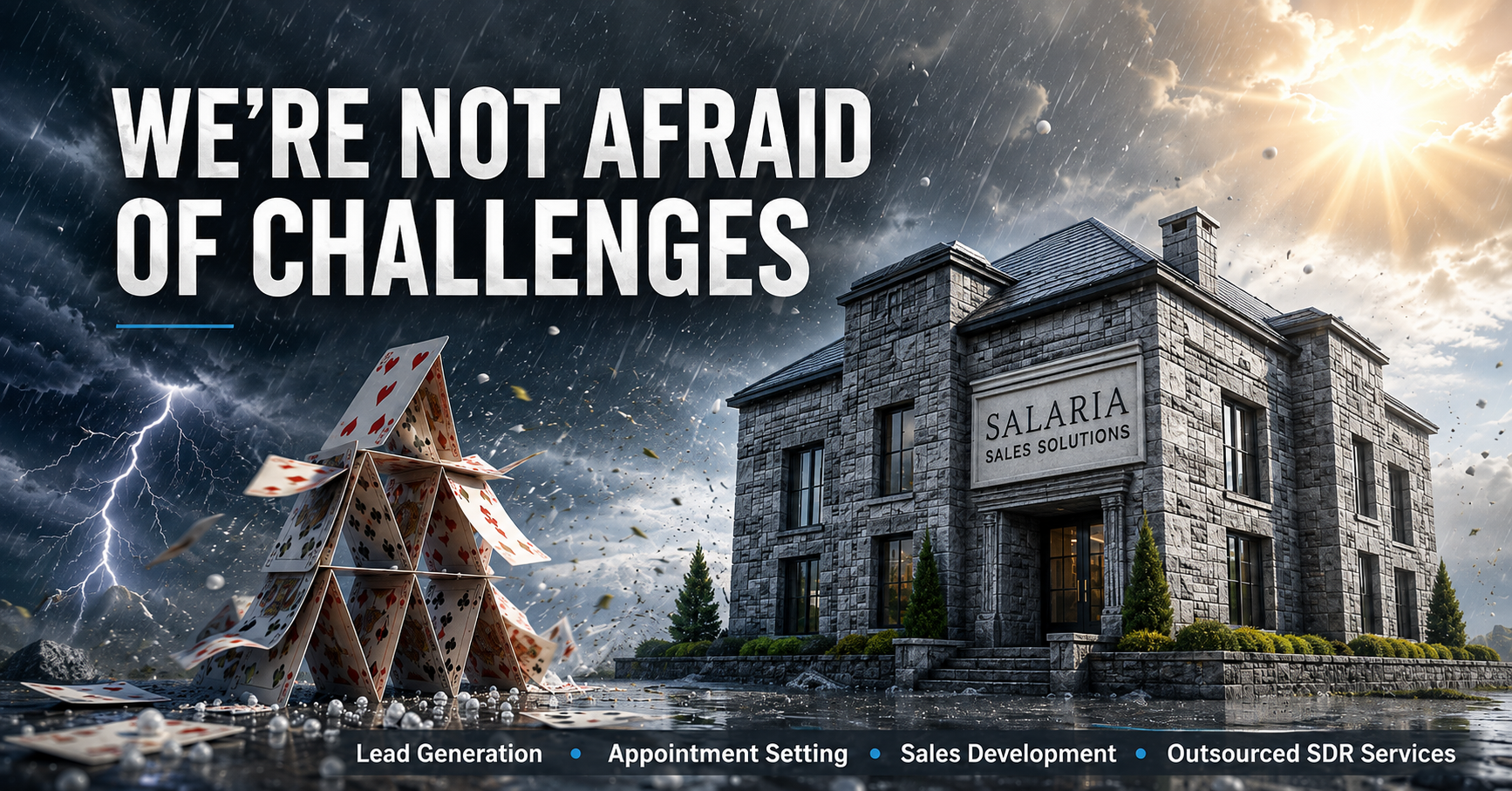
The difference can be visualized as two houses. One is built from playing cards. It may stand when conditions are perfect, but even a relatively small amount of pressure can bring the structure down. A strong gust of wind is enough to expose how fragile the foundation really is.
Some lead generation and outsourced SDR approaches can work in a similar way. They may function when the task is straightforward, but struggle when they encounter objections, complexity or a client that requires a more thoughtful strategy. When something does not fit neatly into an existing approach, the weakness of the model becomes much easier to see.
Salaria is designed around the opposite idea. Instead of a house of cards, think of a house made from granite. Wind, hail, extreme heat and other difficult conditions may surround it, but the foundation remains strong. That represents the way we think about difficult B2B sales development. Complexity is not something that should automatically make the strategy collapse.
We’re Not Afraid of Challenges
Salaria works with businesses that are not always straightforward. Those are exactly the situations where a strong sales development foundation matters. A difficult business requires the team to think about how to develop the right strategy rather than expecting the same approach to work for every client.
That is also why dedicated SDR teams can offer B2B companies an alternative to continually adding internal headcount. The objective is not simply to provide another body making calls or sending outreach. It is to create a leaner sales development model that uses technology effectively while giving the company access to a team capable of taking on difficult prospecting and lead generation challenges.
The old answer to growth was often to hire more SDRs and accept the churn that came with it. Today, companies have another option. They can stay leaner, use technology more effectively and work with a dedicated SDR partner built to handle complexity. For businesses where the sales challenge is not simple, the strength of the foundation matters.