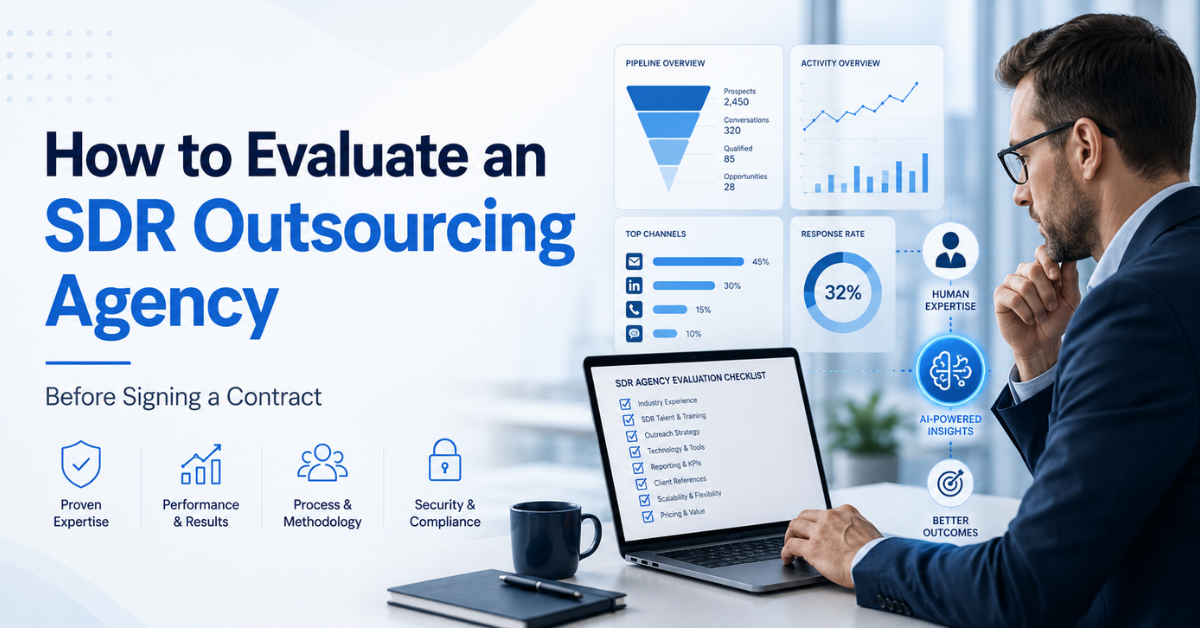
The right SDR Outsourcing Agency does more than book meetings. It gives your sales team a smarter, more human, and more predictable way to build qualified pipeline.
Choosing an SDR Outsourcing Agency is a major decision because the partner you select will represent your brand in front of future customers. For many B2B companies, outsourcing sales development can help accelerate pipeline creation, reduce hiring pressure, and improve outbound execution. However, the wrong agency can waste budget, damage prospect relationships, and fill your sales calendar with poor-fit meetings. Before signing a contract, it is important to evaluate the agency’s strategy, people, process, reporting, technology, and ability to support your buyer journey. The best SDR outsourcing partners do not rely on generic scripts or automated outreach alone. They combine human sales expertise with AI-supported research, targeting, and optimization. This Human-AI sales approach helps companies engage buyers with relevance, context, and consistency. This guide explains how to evaluate an SDR Outsourcing Agency before signing a contract so you can choose a partner that supports long-term growth.
What Is an SDR Outsourcing Agency?
An SDR Outsourcing Agency is a B2B sales development partner that provides outsourced sales development representatives to help companies identify prospects, run outbound outreach, qualify leads, and book meetings for internal sales teams. Instead of hiring, training, and managing SDRs in-house, a company can work with an external agency that already has the people, tools, systems, and management structure needed to run outbound sales development campaigns.
A strong SDR Outsourcing Agency does more than send emails or make calls. It helps define the ideal customer profile, build targeted account lists, develop relevant messaging, manage multi-channel outreach, qualify buyer interest, and hand off qualified opportunities to sales teams. This makes the agency an extension of your revenue team rather than a basic appointment setting vendor.
Modern SDR outsourcing is also becoming more strategic because B2B buyers expect relevance and personalization. AI can support faster research, data enrichment, account scoring, and workflow efficiency. However, human SDRs are still essential for judgment, tone, objection handling, personalization, and real conversations. The strongest agencies use a Human-AI sales approach where technology supports the SDR, but humans lead the buyer relationship.
Why Companies Hire an SDR Outsourcing Agency
Many B2B companies hire an SDR Outsourcing Agency because building an internal SDR team takes time, money, management, and consistent training. Sales development requires daily execution, accurate data, strong messaging, and disciplined follow-up. Outsourcing can help companies move faster while giving their sales teams more time to focus on qualified opportunities.
1. Faster Pipeline Development
An SDR Outsourcing Agency can help companies launch outbound sales development campaigns faster than building a team internally. Hiring internal SDRs often requires recruiting, onboarding, training, sales tools, call systems, email infrastructure, and management support. An experienced agency already has the team and process in place, which can shorten the time needed to begin outreach. This is especially useful for companies launching a new product, testing a new market, or trying to increase sales conversations quickly. However, speed should not come at the cost of strategy, so the agency should still take time to understand your ideal customer profile and buyer journey.
2. Lower Hiring and Management Burden
Hiring SDRs internally can become expensive when you include salaries, commissions, tools, training, management, and employee turnover. Many companies underestimate how much time it takes to coach SDRs, review calls, improve messaging, and maintain consistent activity. An SDR Outsourcing Agency reduces this management burden by providing trained sales development talent and campaign leadership. This allows internal sales leaders to focus more on closing deals, improving the sales process, and supporting account executives. For growing B2B companies, outsourcing can be a practical way to access sales development capacity without building a full internal department immediately.
3. Access to Specialized Sales Development Expertise
A good SDR outsourcing partner brings experience from running outbound sales development campaigns across different industries, buyer personas, and sales cycles. This experience can help improve targeting, messaging, objection handling, and meeting qualification. Agencies that specialize in B2B lead generation often understand how to test outreach, analyze response patterns, and refine campaigns based on market feedback. This can be valuable for companies that do not have a mature outbound sales development function. Instead of starting from zero, they can work with a partner that already understands proven prospecting and qualification methods.
4. Scalable Outbound Sales Development
SDR outsourcing gives companies the flexibility to scale outreach based on business goals, market demand, and sales capacity. If a campaign performs well, the company can often increase activity or expand into new segments more easily than hiring multiple new SDRs. If a market test does not perform as expected, the strategy can be adjusted without the same level of internal hiring risk. This flexibility is useful for startups, mid-market companies, and enterprise teams that need controlled growth. The key is to scale quality, not just volume, because more outreach only matters when it leads to better sales conversations.
5. More Focus for Account Executives
When account executives spend too much time prospecting, they have less time for discovery calls, demos, proposals, negotiation, and closing. An SDR Outsourcing Agency helps separate prospecting from closing by giving SDRs responsibility for outreach and qualification. This allows account executives to focus on buyers who are more likely to have a real need, budget, authority, or interest. The result is a more efficient sales process and better use of senior sales talent. Strong SDR outsourcing should protect the sales team’s calendar by prioritizing qualified meetings over random appointments.
How to Evaluate an SDR Outsourcing Agency Before Signing a Contract
Before signing a contract, you should evaluate the agency across strategy, process, people, reporting, communication, and contract structure. A polished sales pitch is not enough. You need to understand exactly how the agency will represent your brand, engage prospects, qualify opportunities, and support your sales development strategy.
1. Review Their Understanding of Your Ideal Customer Profile
Your ideal customer profile is the foundation of successful B2B lead generation. Before choosing an SDR Outsourcing Agency, assess whether they ask detailed questions about your target industries, company size, buyer roles, pain points, buying triggers, and disqualification criteria. If an agency jumps straight into outreach volume without understanding your ICP, that is a warning sign. Strong agencies know that better targeting improves reply quality, meeting relevance, and pipeline conversion. They should also explain how they will refine the ICP using campaign data and feedback from your sales team.
2. Evaluate Their Sales Development Strategy
A good SDR outsourcing partner should have a clear sales development strategy, not just a list of outreach tasks. Ask how they plan campaigns, segment accounts, personalize messaging, manage follow-up, and adjust strategy based on buyer response. Their approach should connect to your buyer journey, from awareness to consideration to sales conversation. For early-stage buyers, messaging may need to educate and create problem awareness. For buyers closer to purchase, messaging should focus on urgency, relevance, proof, and next steps.
3. Assess Their Human-AI Sales Approach
AI can improve outbound sales development, but it should not replace human judgment. Ask how the agency uses AI for prospect research, account prioritization, data enrichment, personalization support, and campaign optimization. Then ask how human SDRs review the information and turn it into relevant buyer conversations. A strong Human-AI sales approach helps improve speed without losing personalization. Avoid agencies that rely only on automation, because generic outreach can reduce response rates and damage your brand reputation.
4. Check Their Outreach Channels
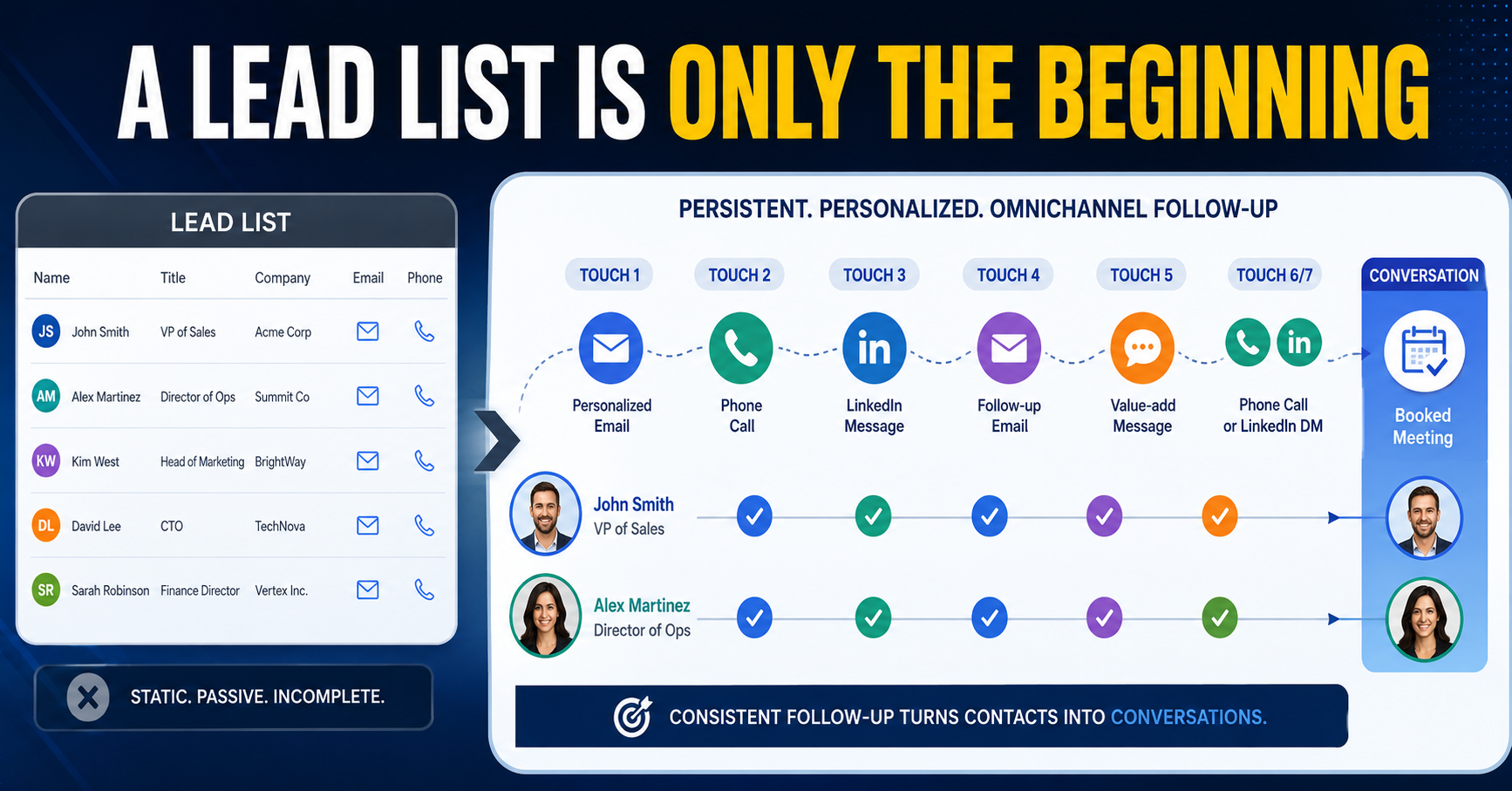
Modern outbound sales development usually works best when it uses multiple channels, including email, cold calling, LinkedIn outreach, social selling, and structured follow-up. Ask which channels the agency uses and how they decide the best channel mix for your market. Some buyers respond better to phone calls, while others engage first through email or LinkedIn. The agency should not use the same outreach strategy for every client. A strong partner will test channel performance, analyze engagement patterns, and refine campaigns based on real buyer behavior.
5. Understand Their Lead Qualification Process
Meeting volume is not enough if the meetings are not qualified. Ask how the agency defines a qualified meeting and what criteria they use before handing prospects to your sales team. Strong qualification should consider account fit, buyer role, business need, interest level, timing, and next-step relevance. The agency should understand the difference between a curious prospect and a sales-ready opportunity. A better qualification process helps your internal team spend time on conversations that have a higher chance of becoming pipeline.
6. Review Their Messaging and Personalization Quality
The agency’s messaging will represent your company in the market, so it must be clear, relevant, and professional. Ask to review sample email copy, call scripts, LinkedIn messages, and follow-up sequences. The messaging should speak to the prospect’s role, business challenge, industry context, and likely priorities. It should not sound robotic, overly aggressive, or generic. Strong agencies continuously test messaging and improve it based on replies, objections, and conversion data.
7. Ask About SDR Training and Management
The quality of the SDRs assigned to your account matters as much as the campaign strategy. Ask who will work on your account, how they are trained, and how managers review their performance. SDRs should understand your value proposition, buyer personas, qualification rules, objections, and handoff process. Without proper training, outsourced SDRs can sound disconnected from your business. A strong agency provides ongoing coaching, call reviews, messaging feedback, and performance management to maintain quality.
8. Examine Their Reporting and Metrics
A reliable SDR Outsourcing Agency should provide transparent reporting that shows activity, engagement, meeting quality, and pipeline impact. Basic metrics include calls made, emails sent, LinkedIn touches, replies, and meetings booked. Stronger metrics include completed meetings, sales accepted opportunities, no-show rates, conversion rates, disqualification reasons, and pipeline created. Good reporting should explain what is working, what is not working, and what changes are being made. The best agencies turn reporting into strategic insight, not just a spreadsheet of activity.
9. Clarify Communication and Collaboration
SDR outsourcing works best when the agency acts like an extension of your sales team. Ask how often you will meet, who your main point of contact will be, and how campaign feedback will be handled. There should be a clear rhythm for weekly reviews, messaging updates, performance discussions, and sales team feedback. If your account executives reject meetings or notice quality issues, the agency should respond quickly and adjust the campaign. Strong communication helps prevent misalignment and keeps the outbound sales development program improving over time.
10. Study the Contract Terms Carefully
Before signing, review the contract for scope, deliverables, pricing, timelines, cancellation terms, minimum commitments, data ownership, reporting expectations, and service levels. Make sure you understand what is included and what costs extra. Some agencies may charge separately for list building, technology, strategy, reporting, or additional outreach channels. You should also clarify what happens if performance is below expectations. A good contract should define responsibilities clearly and avoid vague promises that are not connected to measurable work.
Important Questions to Ask an SDR Outsourcing Agency
Asking the right questions helps you identify whether the agency is a strategic partner or a basic outreach vendor. These questions also reveal how the agency thinks about quality, accountability, buyer experience, and long-term pipeline value.
1. How do you define a qualified meeting?
This question is important because every agency may define qualification differently. Some agencies count any booked call as success, while stronger agencies focus on fit, need, role, interest, and business context. You should ask what information they collect before booking a meeting and how they confirm the prospect matches your ideal customer profile. A qualified meeting should give your sales team a real opportunity to create pipeline. If the qualification standard is too loose, your sales team may waste time with poor-fit prospects.
2. How do you build and validate prospect lists?
Prospect data quality has a direct impact on campaign performance. Ask where the agency gets data, how it verifies contacts, and how often it refreshes lists. Poor data can lead to bounced emails, low connection rates, irrelevant outreach, and weak campaign results. Strong agencies use a combination of data tools, research, validation, and human review. They should also be able to segment lists by industry, company size, buyer role, location, buying signals, and account fit.
3. How do you personalize outreach?
Personalization is one of the biggest differences between weak outreach and effective outbound sales development. Ask whether personalization happens at the persona level, account level, or individual level. The agency should explain how it uses buyer pain points, company context, industry trends, and role-specific priorities in messaging. AI can help collect useful research, but humans should review and refine outreach before it reaches prospects. Strong personalization helps your message feel relevant instead of automated.
4. How do you handle objections?
Objection handling is a critical SDR skill. Prospects may say they are not interested, already have a vendor, lack budget, are too busy, or are not the right person. Ask how SDRs are trained to respond to these situations and how objections are documented. A strong agency uses objections as learning signals to improve targeting and messaging. SDRs should be persistent but respectful, because the goal is to create trust, not pressure buyers.
5. What happens after a meeting is booked?
The handoff process can determine whether a meeting becomes pipeline. Ask what information the SDR provides to your sales team before the call. This may include prospect background, pain points, interest level, outreach history, objections, timing, and recommended next steps. A weak handoff creates friction for the account executive and reduces meeting quality. A strong handoff helps the sales team enter the conversation prepared and confident.
6. How do you optimize campaigns over time?
Outbound sales development should improve as data is collected. Ask how the agency reviews results, tests messaging, adjusts targeting, and uses feedback from your sales team. Strong agencies look at response patterns, objection trends, meeting outcomes, conversion rates, and pipeline movement. They do not simply repeat the same sequence every month. Continuous optimization is especially important in complex B2B sales cycles where buyer behavior changes by industry, persona, and market maturity.
7. Who owns the data and campaign assets?
Before signing a contract, clarify ownership of prospect lists, messaging, call notes, CRM records, reports, and campaign insights. Your company should have access to the information generated during the engagement. This matters because outbound campaigns can create valuable market intelligence beyond booked meetings. If the relationship ends, you should know what data and assets remain available to your team. Transparent data ownership is a sign of a professional and trustworthy agency.
Red Flags to Watch Before Signing a Contract
Not every SDR Outsourcing Agency is the right fit. Some agencies may promise fast results without the process needed to create sustainable pipeline. Watch for these warning signs before making a decision.
1. They Promise Guaranteed Revenue Without Understanding Your Sales Cycle
An agency can influence outbound activity, meeting quality, and pipeline creation, but it cannot fully control your close rates, pricing, product-market fit, or buyer decision-making. Be cautious if an agency guarantees revenue before understanding your sales cycle, average deal size, market, and conversion rates. Realistic agencies discuss assumptions and explain what factors affect results. They focus on building a measurable sales development system. Overpromising early can lead to disappointment after the contract is signed.
2. They Focus Only on Meeting Volume
High meeting volume may look impressive, but it does not always create revenue. If an agency focuses only on the number of booked meetings, ask how it measures meeting quality and sales acceptance. Poor-fit meetings waste your sales team’s time and can reduce confidence in the outbound program. A better agency will care about conversion from meeting to opportunity and opportunity to pipeline. Quality should always be part of the performance conversation.
3. They Use Generic Messaging
Generic messaging usually leads to weak buyer engagement. If the agency cannot show how messaging will be tailored to your audience, industry, and value proposition, that is a concern. Buyers receive many sales messages, so relevance is critical. Good outreach should quickly explain why the message matters to the prospect. A strong agency will test and refine messaging instead of relying on the same template for every campaign.
4. They Cannot Explain Their Process Clearly
A professional agency should be able to explain its process from onboarding to reporting. This includes ICP development, list building, messaging, outreach, qualification, meeting booking, handoff, and optimization. If the process sounds vague, the campaign may be difficult to manage. Clear process creates accountability and makes it easier to identify where improvements are needed. If the agency cannot explain how work gets done, it may not be ready to support your growth goals.
5. They Avoid Discussing Performance Metrics
Transparency is essential in SDR outsourcing. If an agency avoids discussing metrics, reporting, or meeting quality, you should be cautious. Strong partners are comfortable reviewing activity, engagement, meetings, sales acceptance, and pipeline impact. They should also be willing to discuss underperformance and explain corrective actions. A lack of reporting makes it difficult to know whether your investment is working.
How to Compare SDR Outsourcing Agencies
Comparing agencies requires more than reviewing price. The lowest-cost option may not deliver the best value if it creates weak meetings, poor messaging, or brand risk. A better comparison looks at strategy, people, technology, reporting, and accountability.
1. Compare Strategy, Not Just Services
Many agencies offer similar services, such as cold calling, email outreach, LinkedIn outreach, and appointment setting. The difference is how those services are planned and executed. Ask how each agency builds campaigns around your ICP, buyer journey, sales cycle, and market position. A strategic agency connects every activity to a revenue goal. A basic vendor may simply run outreach without understanding the deeper business objective.
2. Compare Quality of People
The SDRs and managers assigned to your account will shape the success of the campaign. Ask about their experience, training, coaching, and familiarity with B2B sales development. Good SDRs need communication skills, persistence, curiosity, judgment, and the ability to handle objections professionally. They also need to know when to move a conversation forward and when to protect the buyer experience. Strong account managers help translate campaign results into better strategy.
3. Compare Technology and Human Oversight
Technology can improve efficiency, but it should not create robotic outreach. Ask which tools the agency uses for data, sequencing, calling, CRM management, deliverability, analytics, and AI-supported research. Then ask how human SDRs review and control the work. The best approach uses AI to support research and prioritization while relying on people for personalization, conversation, and qualification. This balance helps maintain both scale and quality.
4. Compare Reporting Depth
A basic activity report is not enough to evaluate campaign success. Look for reporting that shows engagement rates, response quality, completed meetings, sales accepted opportunities, disqualification reasons, and pipeline influence. Reporting should help you make better decisions, not just confirm that outreach happened. Strong agencies provide insights that can improve targeting, messaging, and sales strategy. Better reporting also makes it easier to explain campaign performance to leadership.
5. Compare Contract Flexibility
Contract flexibility matters because outbound sales development often requires testing and adjustment. Review minimum commitments, cancellation terms, ramp periods, and what happens if the campaign needs to pivot. Long contracts are not always bad, but they should come with clear expectations and accountability. A flexible structure can reduce risk while the relationship is being tested. Make sure the contract supports learning, improvement, and growth.
Key Metrics to Track After Hiring an SDR Outsourcing Agency
Once the campaign begins, you need to track the right metrics. Activity matters, but pipeline quality matters more. The strongest performance reviews connect SDR activity to sales outcomes.
1. Activity Metrics
Activity metrics show whether the team is executing the campaign consistently. These include calls made, emails sent, LinkedIn touches, follow-ups completed, and accounts contacted. Activity metrics are useful because they show whether the agreed outreach plan is being delivered. However, activity should not be the only measure of success. High activity with weak targeting or poor messaging can still create poor results.
2. Engagement Metrics
Engagement metrics show how prospects are responding to outreach. These include reply rates, call connection rates, LinkedIn responses, positive replies, objections, and referral responses. Engagement data helps reveal whether your targeting and messaging are relevant. If engagement is low, the campaign may need better segmentation, clearer messaging, improved data, or a different channel mix. Strong agencies use engagement data to improve campaigns continuously.
3. Meeting Metrics
Meeting metrics include meetings booked, meetings completed, no-show rates, reschedule rates, and sales accepted meetings. These numbers help you evaluate whether booked meetings are actually creating value. For example, if many meetings are booked but few are completed, the agency may need to improve confirmation and qualification. If sales acceptance is low, the ICP or qualification criteria may need to be reviewed. Meeting quality should always be measured alongside meeting quantity.
4. Pipeline Metrics
Pipeline metrics show whether SDR outsourcing is creating business impact. These include opportunities created, pipeline value, meeting to opportunity conversion, deal progression, and revenue influenced by SDR activity. These metrics may take longer to appear, especially in complex B2B sales cycles. However, they are essential for understanding return on investment. A strong agency will want feedback on pipeline outcomes so it can improve targeting and qualification.
5. Learning Metrics
Learning metrics capture insights from the market. These may include common objections, competitor mentions, buyer pain points, timing issues, budget concerns, and reasons prospects decline meetings. This information can help improve sales messaging, product positioning, content strategy, and buyer education. Even when prospects do not convert immediately, their feedback can still be valuable. A good SDR Outsourcing Agency turns market feedback into better decision-making.
Practical Benchmarks to Discuss With Your SDR Outsourcing Partner
Every market is different, so you should establish your own baseline during the first phase of the campaign. Instead of judging performance by one number, review multiple conversion points across the funnel. Useful benchmarks include positive reply rate, call connection rate, meeting completion rate, sales accepted rate, and meeting to opportunity conversion. For example, if 40 meetings are booked and 10 become sales accepted opportunities, the sales accepted rate is 25 percent. This type of tracking helps you understand whether the agency is producing activity, qualified conversations, or true pipeline potential.
You should also separate leading indicators from lagging indicators. Leading indicators include list quality, response quality, objection patterns, and meeting completion rate. Lagging indicators include pipeline created, revenue influenced, and closed deals. A strong SDR outsourcing program improves both over time. The goal is not to chase one isolated metric, but to understand how each part of the buyer journey is performing.
How Long Does It Take to See Results from SDR Outsourcing?
Most SDR outsourcing programs need a ramp period because the agency must learn your market, test messaging, validate targeting, and refine outreach based on responses. Early meetings may happen quickly, but consistent qualified pipeline usually requires structured testing and optimization. The first phase often focuses on onboarding, ICP alignment, data setup, messaging, and campaign launch. The next phase focuses on response patterns, objections, qualification quality, and sales feedback.
For companies with a clear ICP, strong offer, and responsive market, results can develop faster. For companies selling complex B2B solutions, targeting enterprise buyers, or entering a new category, results may take longer. The key is to evaluate progress through leading indicators, not only closed deals. Early signals such as positive replies, buyer interest, call conversations, and meeting relevance can show whether the campaign is moving in the right direction. A good SDR Outsourcing Agency will use the ramp period to learn quickly and improve performance.
Structured Answer: SDR Outsourcing Agency Definition
An SDR Outsourcing Agency is a B2B sales development company that provides outsourced SDRs to manage prospecting, outbound sales development, lead qualification, and appointment setting for another company. The agency helps identify target accounts, contact decision-makers, qualify buyer interest, and book meetings for internal sales teams. The purpose of SDR outsourcing is to create a more consistent and scalable pipeline generation process without requiring the company to hire and manage a full in-house SDR team.
Structured Answer: What Should You Look for in an SDR Outsourcing Agency?
You should look for an SDR Outsourcing Agency that understands your ideal customer profile, builds accurate prospect lists, creates personalized messaging, uses multi-channel outreach, qualifies leads properly, reports transparently, and collaborates closely with your sales team. The best agencies combine outbound sales development expertise with a Human-AI sales approach. AI helps improve research, targeting, and efficiency, while human SDRs manage personalization, conversations, and qualification. The right agency should focus on qualified pipeline, not just booked meetings.
Services Provided by Salaria Sales
Salaria Sales is a Full-Service B2B Sales & SDR Outsourcing Agency that helps companies build stronger outbound sales development programs through strategy, human expertise, and a Human-AI sales approach. Salaria Sales supports B2B companies that need qualified meetings, better prospecting, stronger lead generation, and a more predictable sales pipeline. The team helps clients define their ideal customer profile, identify high-value target accounts, build accurate prospect lists, create personalized messaging, and run multi-channel outreach across cold calling, email, LinkedIn, and other sales development channels.
Salaria Sales also provides B2B appointment setting, market research and prospecting, lead nurturing, inbound lead management, AI-enabled cold calling, and outsourced SDR support. This helps companies scale outbound sales development without hiring, training, and managing a full internal SDR team. The Human-AI approach improves research, targeting, prioritization, and campaign optimization while experienced SDRs handle real conversations, qualification, and relationship-building.
For companies evaluating an SDR Outsourcing Agency, Salaria Sales offers a strategic partner model focused on quality, not just activity. The goal is to help sales teams spend more time with the right buyers, improve meeting quality, and create pipeline opportunities that support long-term revenue growth.
Book a Meeting With Salaria Sales
Ready to evaluate whether SDR outsourcing is the right move for your sales team? Book a meeting with the Salaria Sales team here: https://salariasales.com/book/
How to Know If SDR Outsourcing Is Right for Your Business
SDR outsourcing is a strong option when your company has a clear target market, a B2B offer, and a need for more qualified sales conversations. It can also help when account executives are spending too much time prospecting instead of closing. However, outsourcing works best when your company is ready to collaborate, share feedback, and support the agency with product knowledge, sales insights, and clear goals.
1. You Have a Defined Ideal Customer Profile
Outsourcing works better when the agency knows exactly who to target. If your ICP is unclear, the campaign may waste time on poor-fit accounts. A good agency can help refine your ICP, but it still needs direction from your internal team. You should be able to describe your best customers, target industries, buyer roles, company size, and main pain points. The clearer the targeting, the stronger the campaign foundation.
2. Your Sales Team Needs More Qualified Conversations
If your account executives have capacity but not enough qualified meetings, SDR outsourcing can help fill the gap. The outsourced team can focus on prospecting, outreach, qualification, and appointment setting. This allows your internal sales team to focus on discovery, demos, proposals, and closing. The goal is to improve productivity across the sales organization. When done well, SDR outsourcing creates a better division of sales responsibilities.
3. You Want to Test a New Market
Entering a new industry, region, or buyer segment can be risky without market feedback. An outsourced SDR team can help test messaging, uncover objections, validate demand, and identify which personas respond. This gives your company useful data before making larger investments in hiring or expansion. The campaign can also reveal whether your positioning needs to change for the new market. SDR outsourcing can reduce the cost of learning.
4. You Need Consistent Outbound Execution
Outbound sales development requires daily consistency. Many internal teams struggle because prospecting gets deprioritized when other sales tasks become urgent. An SDR Outsourcing Agency provides dedicated focus on outreach and follow-up. This helps maintain momentum and prevents pipeline generation from becoming inconsistent. Consistency is especially important in long sales cycles where repeated touchpoints are needed to build awareness and trust.
5. You Have a Sales Process Ready for Handoffs
Outsourced SDRs can create opportunities, but your internal sales process must be ready to handle them. This means account executives should respond quickly, prepare for meetings, update CRM records, and provide feedback on lead quality. Without a strong handoff process, good meetings can be wasted. The best results happen when the agency and sales team work closely together. SDR outsourcing should support your sales motion, not operate separately from it.
Final Checklist Before Signing an SDR Outsourcing Contract
Before you commit, use this checklist to reduce risk and make a better decision.
1. Confirm the Agency Understands Your ICP
Make sure the agency can explain your target buyers, industries, pain points, and qualification criteria. If they cannot repeat your ICP clearly, they are not ready to represent your brand. This step protects campaign quality from the beginning. It also helps prevent wasted outreach to poor-fit accounts. A strong ICP conversation is one of the best signs of a serious partner.
2. Review the Outreach Strategy
Ask for a clear explanation of the planned channels, messaging, cadence, and campaign structure. The strategy should be specific to your market, not copied from a generic template. It should explain how outreach will change based on buyer persona and buying stage. A strong strategy gives you confidence in how the agency will approach your market. It also gives you a benchmark to evaluate performance later.
3. Agree on Qualification Standards
Define what counts as a qualified meeting before the campaign starts. Include fit, role, need, interest, timing, and any disqualification rules. This prevents confusion between your sales team and the agency. It also helps ensure that meeting quality is measured consistently. Strong qualification standards protect the value of your sales team’s time.
4. Clarify Reporting and Review Cadence
Agree on what reports you will receive, how often you will meet, and which metrics will be reviewed. The reporting should include both activity and outcome metrics. It should also include insights from prospect conversations. Regular reviews help identify what needs to improve. Without reporting discipline, it is difficult to manage performance.
5. Review Contract Flexibility and Ownership
Before signing, understand the contract length, cancellation terms, pricing structure, deliverables, and data ownership. Make sure you know what happens if the campaign needs to change. You should also confirm that your company has access to relevant campaign data and insights. Clear contract terms reduce misunderstandings. A transparent agency will be willing to explain everything before you commit.
Frequently Asked Questions
1. What is an SDR Outsourcing Agency?
An SDR Outsourcing Agency is a company that provides outsourced sales development representatives to help B2B businesses generate leads, contact prospects, qualify opportunities, and book meetings for internal sales teams. The agency typically manages prospect research, list building, email outreach, cold calling, LinkedIn outreach, follow-up, qualification, reporting, and campaign optimization. This allows businesses to scale outbound sales development without hiring an internal SDR team. A strong agency works as a strategic partner, not just a meeting booking vendor. The best agencies combine human sales expertise with AI-supported research and targeting to improve both efficiency and quality.
2. How do I choose the right SDR Outsourcing Agency?
To choose the right SDR Outsourcing Agency, evaluate its strategy, team quality, ICP understanding, outreach process, qualification standards, reporting, communication, and contract terms. Ask how the agency builds target lists, personalizes outreach, trains SDRs, uses AI, measures meeting quality, and optimizes campaigns over time. You should also review sample messaging and clarify what counts as a qualified meeting. The right agency should understand your buyer journey and revenue goals. It should be transparent, collaborative, and focused on creating qualified pipeline instead of simply increasing activity.
3. Is SDR outsourcing better than hiring an internal SDR team?
SDR outsourcing can be better when a company needs faster execution, lower hiring burden, sales development expertise, or flexible scaling. Hiring internally may be better when a company wants full control, has strong SDR management resources, and can invest in long-term team development. The best choice depends on your budget, timeline, sales process, and growth goals. Many B2B companies use outsourcing to test markets, create pipeline, or support account executives while they build internal capacity. A strong outsourced partner can also work alongside an internal sales team.
4. What should be included in an SDR outsourcing contract?
An SDR outsourcing contract should clearly define services, scope, pricing, deliverables, timelines, reporting, meeting qualification standards, communication cadence, technology responsibilities, cancellation terms, and data ownership. It should also explain whether list building, CRM updates, messaging, calling, email outreach, LinkedIn outreach, and reporting are included. Before signing, ask what happens if campaign performance is below expectations. Clear contract terms help protect the client and the agency. Avoid agreements that rely on vague promises without measurable responsibilities or review processes.
5. How much does SDR outsourcing cost?
The cost of SDR outsourcing varies based on the number of SDRs, campaign complexity, target market, outreach channels, data requirements, management support, and reporting needs. A simple campaign may cost less than a complex enterprise outbound program that requires deep research, multi-channel outreach, and advanced qualification. Instead of choosing only by price, evaluate the expected value of qualified meetings, pipeline creation, and sales team productivity. A low-cost agency may become expensive if it delivers poor-fit meetings. The right investment should align with your average deal size, sales cycle, and revenue goals.
6. How long does it take for SDR outsourcing to work?
SDR outsourcing usually requires a ramp period because the agency needs to learn your market, refine targeting, test messaging, and optimize outreach. Early activity can begin quickly, but consistent qualified pipeline often develops after testing and iteration. The timeline depends on your target market, buyer responsiveness, deal complexity, ICP clarity, and offer strength. Companies should track early indicators such as reply quality, connection rates, meeting relevance, and sales team feedback. A strong agency will use early campaign data to improve performance rather than simply continue the same approach.
7. What is the difference between SDR outsourcing and B2B lead generation?
SDR outsourcing is a form of B2B lead generation, but it is usually more focused on active outbound sales development and qualified meeting creation. B2B lead generation can include many tactics, such as paid ads, content marketing, SEO, webinars, email campaigns, and inbound lead capture. SDR outsourcing specifically uses trained sales development representatives to identify prospects, engage buyers, qualify interest, and book sales conversations. It is especially useful for companies that sell higher-value B2B products or services. The best programs connect SDR activity to a broader sales development strategy.
8. How does a Human-AI sales approach improve SDR outsourcing?
A Human-AI sales approach improves SDR outsourcing by combining AI-supported research, data enrichment, account prioritization, and workflow efficiency with human judgment, personalization, and conversation skills. AI can help SDRs identify better-fit prospects and uncover useful context faster. Human SDRs then apply empathy, relevance, and sales experience to engage buyers in a natural way. This balance helps companies scale outbound sales development without sounding robotic or generic. The strongest results come when AI supports the SDR, but humans remain responsible for message quality and buyer relationships.
9. What metrics should I track with an SDR Outsourcing Agency?
You should track activity metrics, engagement metrics, meeting metrics, pipeline metrics, and learning metrics. Activity metrics include calls, emails, LinkedIn touches, and follow-ups. Engagement metrics include replies, conversations, objections, and positive responses. Meeting metrics include meetings booked, meetings completed, no-show rates, and sales accepted meetings. Pipeline metrics include opportunities created, pipeline value, conversion rates, and revenue influenced. Learning metrics include market feedback, objections, competitor mentions, and buyer pain points. Together, these metrics show whether the campaign is creating real business value.
10. When should a company hire an SDR Outsourcing Agency?
A company should consider hiring an SDR Outsourcing Agency when it needs more qualified sales conversations, wants to scale outbound sales development, lacks internal SDR capacity, or wants to test a new market. It is also useful when account executives are spending too much time prospecting instead of closing deals. SDR outsourcing works best when the company has a clear ICP, a defined offer, and a sales team ready to handle qualified meetings. The agency should support the company’s buyer journey and revenue goals. Strong collaboration between both teams is essential for success.
Conclusion
Choosing the right SDR Outsourcing Agency is not just a vendor decision. It is a strategic sales development decision that can shape your pipeline, brand reputation, and revenue performance. Before signing a contract, look beyond meeting promises and evaluate the agency’s ICP process, outreach strategy, qualification standards, SDR training, Human-AI sales approach, reporting, and contract transparency. The best partner will focus on meaningful conversations with the right buyers, not just activity volume. They will understand your market, protect your sales team’s time, and continuously improve campaigns based on data and feedback. SDR outsourcing can be a powerful growth lever when it is built on strategy, quality, and collaboration. If your goal is to create a more predictable pipeline and improve outbound sales development, choose a partner that can operate like an extension of your team.
Ready to build a stronger outbound sales development engine with a Human-AI sales approach? Book a meeting with the Salaria Sales team.