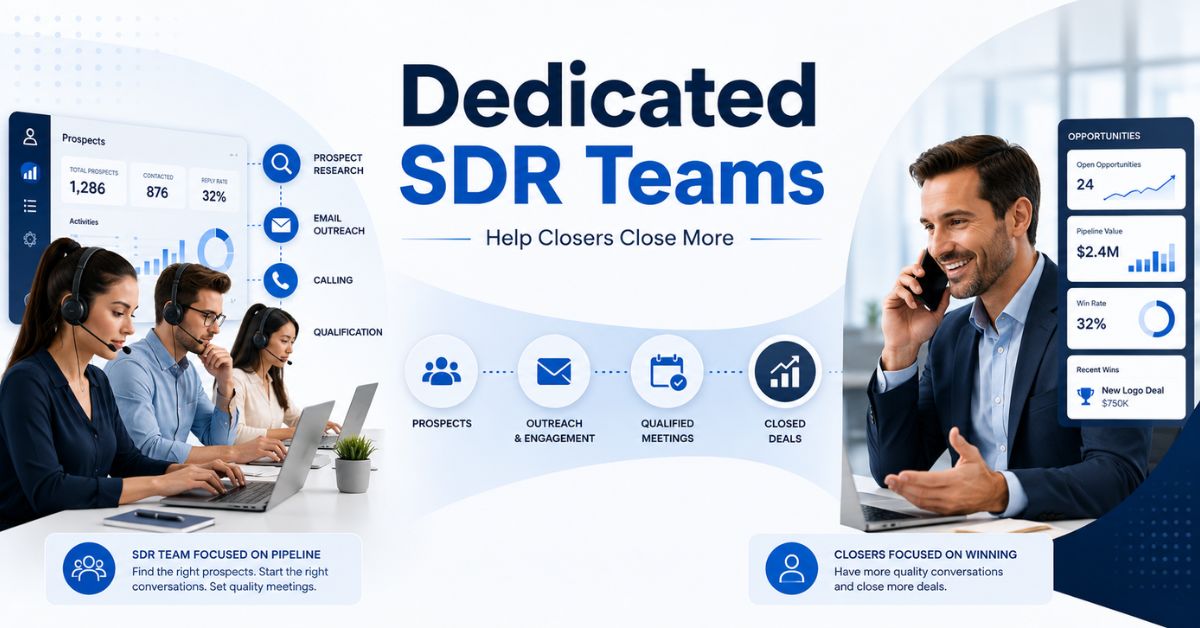
Dedicated SDR Teams help closers do what they do best. Salaria Sales builds focused outbound systems that keep prospecting, qualification, and meeting generation moving while your sales team focuses on revenue.
Many B2B sales teams expect account executives to handle everything from prospecting and cold outreach to discovery, proposals, negotiations, and closing. At first, this may seem efficient, especially for lean sales organizations. In reality, it often creates a hidden productivity problem. Closers spend too much time researching accounts, chasing cold prospects, writing outreach messages, and qualifying leads instead of focusing on high-value sales conversations. Dedicated SDR Teams solve this problem by separating sales development from closing activity. They manage outbound sales development, B2B lead generation, prospect qualification, appointment setting, and follow-up so account executives can spend more time moving serious opportunities forward. In complex B2B sales, this role specialization can significantly improve pipeline quality and sales efficiency. When supported by a Human-AI Sales Approach, Dedicated SDR Teams can target better accounts, personalize outreach, and create more qualified meetings. This article explains how dedicated SDR support helps closers focus, improve productivity, and drive stronger revenue outcomes.
What Are Dedicated SDR Teams
Dedicated SDR Teams are specialized sales development teams focused on prospecting, outbound outreach, qualification, appointment setting, and early-stage pipeline generation for a specific company, campaign, market, or sales motion.
1. Dedicated SDR Teams Own the Top of the Funnel
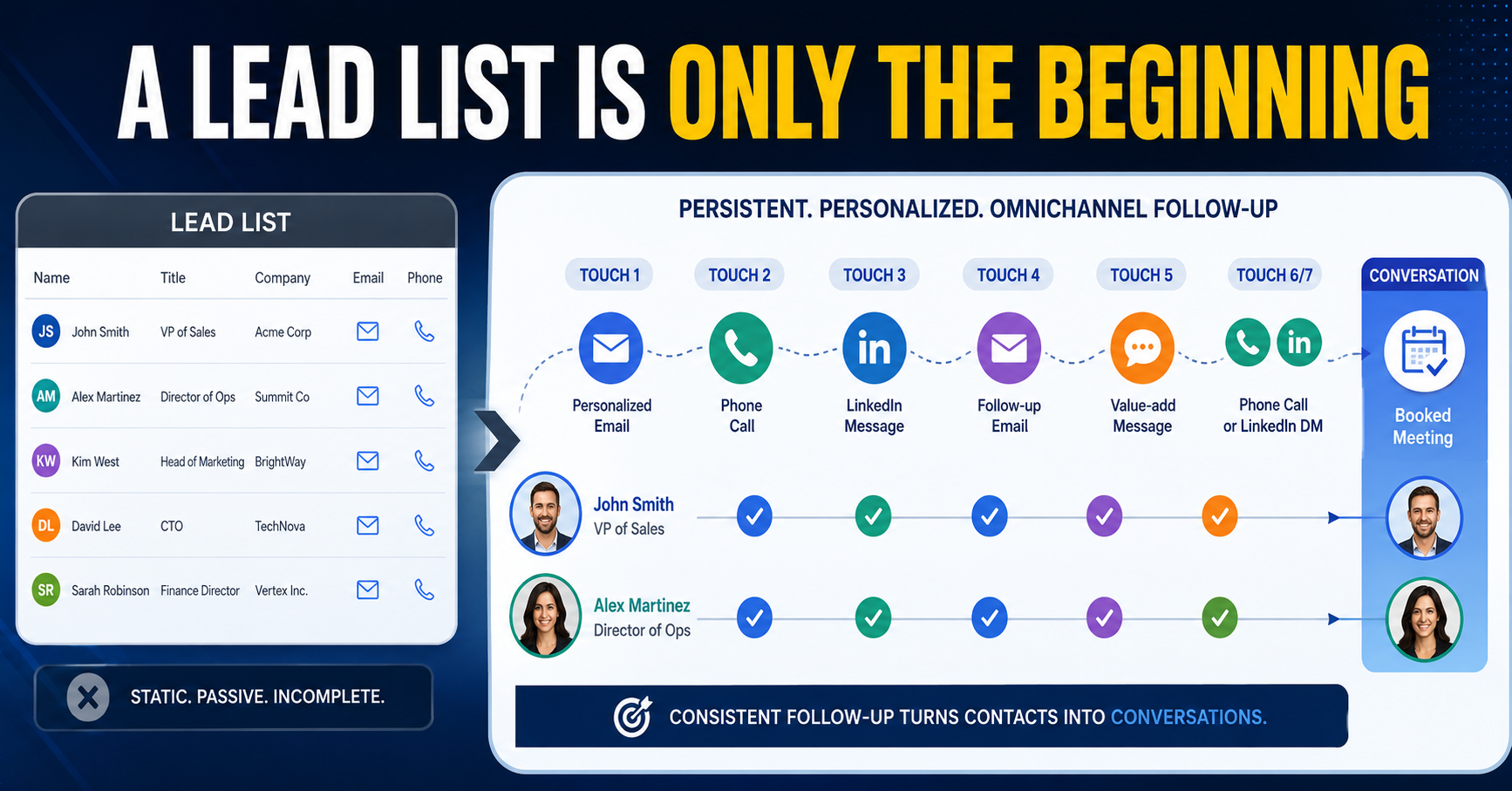
Dedicated SDR Teams focus on the early stages of the sales process where prospects are identified, researched, contacted, and qualified. This includes building target lists, sending personalized emails, making cold calls, engaging prospects on LinkedIn, and managing follow-up. Their job is to create meaningful sales conversations before account executives get involved. This allows the sales team to operate with greater focus and efficiency. When SDRs own the top of the funnel, closers can spend more time on qualified buyers and less time on cold prospecting.
2. Dedicated SDR Teams Create Role Specialization
Sales performance improves when each role focuses on its highest-value work. SDRs are specialized in outreach, qualification, objection handling, and appointment setting, while account executives are specialized in discovery, solution development, negotiation, and closing. When one person tries to do everything, performance often suffers at every stage. Dedicated SDR Teams create a clearer division of labor and stronger accountability. This structure helps businesses improve both prospecting consistency and closing productivity.
3. Dedicated SDR Teams Improve Pipeline Consistency
One of the biggest challenges in B2B sales is maintaining consistent pipeline generation. Account executives may prospect heavily when their calendars are light, then stop prospecting when they are busy with active deals. This creates pipeline gaps that appear later. Dedicated SDR Teams solve this by keeping outbound sales development active every week. Consistent prospecting helps businesses avoid revenue swings and build a more predictable sales pipeline.
4. Dedicated SDR Teams Support Complex Sales Motions
Complex B2B sales often require deeper research, multiple touchpoints, and careful qualification before a prospect is ready for a sales conversation. Dedicated SDR Teams can focus on mapping accounts, identifying decision-makers, understanding buyer roles, and warming up prospects through multi-channel outreach. This creates better context before a meeting reaches the closer. In complex sales environments, this preparation can make a major difference in meeting quality. Better-qualified meetings create stronger opportunities for account executives.
Why Closers Should Not Own the Entire Sales Process
Closers are usually most valuable when they are speaking with qualified prospects, handling discovery, building proposals, and moving deals toward revenue. When they are responsible for the entire sales process, the business often loses efficiency.
1. Prospecting Takes Time Away From Closing
Prospecting requires research, list building, outreach writing, calling, follow-up, CRM updates, and qualification. These tasks are important, but they are not always the best use of a closer’s time. Account executives are typically hired and compensated to convert qualified opportunities into revenue. When they spend large portions of their day on prospecting, fewer hours are available for active deals. Dedicated SDR Teams protect closing time by managing the work that happens before a sales-ready meeting.
2. Closers May Prospect Inconsistently
Even strong account executives often prospect inconsistently because closing work naturally takes priority. When active deals heat up, prospecting gets pushed aside. When the pipeline becomes thin, prospecting resumes under pressure. This cycle creates inconsistent pipeline flow and makes forecasting harder. Dedicated SDR Teams maintain consistent outreach regardless of what is happening in the later sales stages.
3. Different Skills Are Needed at Different Sales Stages
Prospecting and closing require different strengths. SDRs need persistence, research discipline, concise messaging, and the ability to start conversations quickly. Closers need discovery skills, business acumen, negotiation ability, and deal management expertise. Some salespeople can do both, but expecting every closer to excel at every stage creates inefficiency. Dedicated SDR Teams allow each function to develop the skills needed for its stage of the buyer journey.
4. Full-Cycle Selling Can Hide Performance Problems
When account executives own everything, it becomes harder to diagnose where the sales process is breaking down. A pipeline problem may be caused by weak targeting, poor outreach, poor qualification, weak discovery, or slow follow-up. Dedicated SDR Teams create clearer visibility into top-of-funnel performance. Leaders can measure prospecting activity, meeting quality, sales acceptance, opportunity conversion, and close rates separately. This makes it easier to improve the full revenue engine.
How Dedicated SDR Teams Help Closers Spend More Time Closing
Dedicated SDR Teams improve sales productivity by removing low-leverage tasks from closers and improving the quality of meetings that reach them.
1. They Handle Prospect Research and List Building
Dedicated SDR Teams take ownership of identifying target accounts and finding the right contacts inside those organizations. This includes researching company size, industry, buyer roles, growth signals, pain points, and potential buying triggers. Closers no longer need to spend hours building lists or validating contact data. Better research also improves outreach relevance and qualification quality. When SDRs handle research properly, account executives receive better-prepared opportunities.
2. They Manage Outbound Outreach
Outbound sales development requires consistent execution across email, phone, LinkedIn, and follow-up. Dedicated SDR Teams manage this outreach rhythm so closers do not have to. This keeps the pipeline moving even when account executives are focused on active deals. SDRs can test messaging, manage cadences, and respond to early-stage buyer interest. This allows closers to step in when the prospect is more prepared for a serious sales conversation.
3. They Qualify Prospects Before Meetings
One of the most valuable roles of Dedicated SDR Teams is qualification. SDRs confirm whether a prospect matches the Ideal Customer Profile, has a relevant need, understands the reason for the meeting, and has enough interest to move forward. This prevents account executives from wasting time on weak-fit prospects. Strong qualification improves meeting-to-opportunity conversion. It also helps closers prepare better because they receive useful context before the call.
4. They Create Cleaner Sales Handoffs
A good SDR handoff includes the prospect’s role, company context, pain points, objections, timeline, and reason for interest. This gives account executives a stronger starting point for discovery. Without a clean handoff, the closer may need to repeat basic qualification questions and rebuild context from the beginning. Dedicated SDR Teams improve the buyer experience by making the transition from outreach to sales conversation smoother. A stronger handoff helps closers move faster and create more relevant discussions.
The Revenue Impact of Dedicated SDR Teams
Dedicated SDR Teams do more than save time. They improve revenue performance by increasing focus, strengthening pipeline quality, and helping sales teams operate more efficiently.
1. Higher Account Executive Productivity
When account executives spend more time with qualified prospects, their productivity improves. They can focus on discovery, stakeholder alignment, proposal development, negotiation, and closing strategy. This increases the amount of time spent on activities directly connected to revenue. Dedicated SDR Teams reduce distractions and allow closers to operate with greater focus. Over time, this can improve sales output without increasing the number of account executives.
2. Better Meeting Quality
A full calendar is not valuable if the meetings are poor quality. Dedicated SDR Teams help ensure that meetings are relevant, qualified, and aligned with the Ideal Customer Profile. This creates a better experience for both the buyer and the account executive. Higher meeting quality improves conversion rates and reduces wasted time. Strong appointment setting should be measured by sales readiness, not just meeting volume.
3. More Predictable Pipeline Generation
Consistent SDR activity helps prevent pipeline gaps. Dedicated SDR Teams maintain prospecting momentum even when closers are busy with active deals. This creates a steadier flow of sales-ready conversations and improves forecasting confidence. Predictable pipeline generation is especially important in complex B2B sales where sales cycles can be long. A consistent top-of-funnel system supports more stable revenue growth.
4. Stronger Sales and Marketing Alignment
Dedicated SDR Teams can also help connect marketing engagement with sales follow-up. They can act on intent signals, content engagement, webinar attendance, inbound interest, and account-based marketing activity. This ensures that marketing-generated interest is followed up with the right timing and message. Better alignment improves lead conversion and reduces missed opportunities. SDRs play an important role in turning market engagement into sales conversations.
What Makes Dedicated SDR Teams Effective
Not every SDR team produces strong results. High-performing teams are built around strategy, training, targeting, technology, and continuous optimization.
1. Clear Ideal Customer Profile Alignment
Dedicated SDR Teams need a clear understanding of the Ideal Customer Profile. This includes the types of companies, buyer roles, pain points, and triggers that indicate strong fit. Without ICP alignment, SDRs may generate meetings that look productive but fail to convert. A clear ICP improves targeting, messaging, and qualification. It also ensures that SDR activity supports the company’s revenue goals.
2. Strong Messaging and Positioning
SDRs need messaging that is relevant, concise, and connected to buyer priorities. Generic messaging often fails because buyers receive too much outbound outreach already. Strong messaging explains why the conversation matters and what problem may be worth discussing. Dedicated SDR Teams should continuously test and refine messaging based on market feedback. Better messaging leads to better engagement and stronger meetings.
3. Multi-Channel Outreach Execution
Modern buyers rarely respond through one channel alone. Effective Dedicated SDR Teams use email, cold calling, LinkedIn, voicemail, and structured follow-up to create multiple relevant touchpoints. Each channel should have a purpose and should support the broader buyer journey. Multi-channel outreach increases visibility and improves response rates. When coordinated well, it creates better B2B sales conversations.
4. Ongoing Coaching and Quality Assurance
Dedicated SDR Teams need regular coaching to maintain performance. This includes call reviews, email feedback, objection handling practice, messaging updates, and performance analysis. Quality assurance helps ensure that SDRs represent the brand professionally and follow qualification standards. Ongoing coaching turns SDR teams into a continuously improving sales development function. Without coaching, performance often becomes inconsistent.
The Role of a Human-AI Sales Approach in Dedicated SDR Teams
A Human-AI Sales Approach helps Dedicated SDR Teams improve efficiency while keeping human expertise at the center of buyer engagement. AI supports research and prioritization, while SDRs create conversations and relationships.
1. AI Helps SDRs Research Faster
AI can help summarize company information, identify buyer signals, and organize account insights. This reduces time spent on repetitive research and helps SDRs prepare more effectively. Faster research allows SDRs to personalize outreach without slowing down execution. However, AI should not replace human judgment. SDRs still need to decide which insights are relevant and how to use them in conversation.
2. AI Supports Better Prospect Prioritization
Not every account deserves the same level of attention. AI can help identify accounts that match the Ideal Customer Profile or show signs of buyer intent. This allows SDRs to focus on higher-potential prospects first. Better prioritization improves productivity and increases the chance of creating sales-ready meetings. Human SDRs then validate the opportunity and engage with the right message.
3. Human SDRs Build Trust and Handle Objections
AI can support preparation, but human SDRs are still essential for buyer conversations. They listen, adapt, clarify, and respond to objections in real time. This is critical in B2B sales because buyers often have nuanced concerns that require thoughtful responses. Human interaction builds trust and creates a better buyer experience. Dedicated SDR Teams are most effective when technology supports human communication rather than replacing it.
4. Human-AI Teams Improve Over Time
A Human-AI Sales Approach creates better feedback loops. AI and analytics can show which messages, channels, and target segments perform best. SDR managers and sales leaders can use this information to coach teams and refine strategy. Human feedback from real conversations also improves future targeting and messaging. This continuous learning helps Dedicated SDR Teams become more effective over time.
Common Mistakes Businesses Make Without Dedicated SDR Teams
Companies that do not separate SDR work from closing activity often face operational and revenue challenges. These mistakes can reduce pipeline quality and make sales growth harder to predict.
1. Expecting Closers to Prospect Consistently
Account executives may understand the target market well, but that does not mean they can consistently manage prospecting while handling active deals. Prospecting often gets delayed when closing work becomes urgent. This leads to pipeline gaps and inconsistent revenue flow. Dedicated SDR Teams solve this problem by keeping top-of-funnel activity moving. Consistency is one of the biggest advantages of a dedicated sales development function.
2. Confusing Activity With Progress
A team may send many emails or make many calls, but that activity does not matter if it does not create qualified opportunities. Without dedicated SDR ownership, prospecting may lack structure and measurement. Sales leaders may see activity but not understand whether the pipeline is improving. Dedicated SDR Teams can be measured against specific outcomes such as sales accepted meetings, opportunity creation, and pipeline contribution. This makes progress easier to evaluate.
3. Allowing Weak Meetings Into the Pipeline
When qualification is rushed or inconsistent, poor-fit meetings enter the sales pipeline. This wastes account executive time and creates inaccurate forecasts. Dedicated SDR Teams can apply qualification standards before the meeting reaches the closer. This improves pipeline hygiene and reduces wasted sales effort. Better qualification leads to better conversion rates.
4. Missing Follow-Up Opportunities
Prospects often need multiple touchpoints before they are ready for a conversation. When closers are busy, follow-up can become inconsistent or forgotten. Dedicated SDR Teams manage nurturing and follow-up so opportunities do not fall through the cracks. This is especially important for prospects who show interest but are not ready immediately. Structured follow-up helps turn early interest into future pipeline.
How to Measure the Impact of Dedicated SDR Teams
Businesses should measure Dedicated SDR Teams by the quality and revenue impact of their work, not just activity volume. The best metrics connect SDR performance to sales outcomes.
1. Sales Accepted Meetings
Sales accepted meetings show whether account executives believe SDR-generated meetings are worth pursuing. This metric is more valuable than total meetings booked because it reflects quality. If sales accepts a high percentage of meetings, SDR targeting and qualification are likely aligned. If acceptance is low, the team may need to refine ICP, messaging, or qualification standards. This metric helps keep SDRs and closers aligned.
2. Meeting-to-Opportunity Conversion Rate
Meeting-to-opportunity conversion measures how many SDR-booked meetings become real sales opportunities. This is one of the strongest indicators of meeting quality. A high conversion rate means SDRs are booking meetings with the right buyers. A low conversion rate suggests weak qualification or poor targeting. Tracking this metric helps businesses understand whether Dedicated SDR Teams are supporting revenue growth.
3. Pipeline Created
Pipeline created measures the revenue potential generated from SDR activity. This helps leadership understand the financial impact of the SDR function. Pipeline should be evaluated by quality, stage movement, and likelihood to close. This prevents teams from inflating pipeline with weak opportunities. Strong Dedicated SDR Teams create pipeline that sales teams can trust.
4. Account Executive Time Recovered
Another important metric is how much time account executives gain by having Dedicated SDR Teams handle prospecting and qualification. This time can be redirected toward discovery calls, follow-up, proposals, negotiations, and closing. Improved time allocation can increase sales productivity and revenue efficiency. While this metric is sometimes harder to measure, it is a major part of the value dedicated SDR support creates. The more time closers spend closing, the stronger the overall sales engine becomes.
Services Provided by Salaria Sales
Salaria Sales helps businesses build and scale Dedicated SDR Teams that improve pipeline quality and allow closers to spend more time closing deals. As a Full-Service B2B Sales & SDR Outsourcing Agency, Salaria Sales combines SDR outsourcing, outbound sales development, B2B lead generation, appointment setting, cold calling, personalized email outreach, LinkedIn outreach, prospect research, and campaign optimization into a complete sales development system. The team works with clients to define Ideal Customer Profiles, identify target accounts, build prospect lists, create relevant messaging, and qualify buyers before meetings reach account executives. Salaria Sales uses a Human-AI Sales Approach to improve research, buyer intent analysis, prioritization, and performance reporting while keeping trained human SDRs responsible for conversations, qualification, and relationship-building. This ensures outreach remains efficient, personalized, and aligned with modern buyer expectations. Clients benefit from stronger meeting quality, better sales handoffs, improved account executive productivity, and more predictable pipeline growth through dedicated SDR execution.
If you want to build Dedicated SDR Teams that help your closers focus on closing more deals, book a meeting with the Salaria Sales team.
Conclusion
Dedicated SDR Teams help businesses create a more focused, efficient, and predictable sales process. When account executives are responsible for prospecting and closing, they often lose valuable time that should be spent on qualified sales conversations. Dedicated SDR support solves this problem by managing research, outreach, qualification, appointment setting, and follow-up at the top of the funnel. This allows closers to focus on discovery, proposals, negotiations, and deal progression. In complex B2B sales, this specialization can improve pipeline quality, sales productivity, and revenue predictability. A Human-AI Sales Approach makes Dedicated SDR Teams even more effective by combining better data, faster research, and smarter prioritization with human conversations and relationship-building. Companies that invest in dedicated sales development are not just adding outbound activity. They are building a revenue system where each role focuses on what it does best. When SDRs create stronger opportunities, closers can close more deals.
Frequently Asked Questions (FAQs)
1. What are Dedicated SDR Teams?
Dedicated SDR Teams are specialized sales development teams focused on prospecting, outbound outreach, qualification, appointment setting, and early-stage pipeline generation.
2. How do Dedicated SDR Teams help closers?
Dedicated SDR Teams help closers by handling prospecting, research, follow-up, and qualification so account executives can focus on discovery, proposals, and closing deals.
3. Why should account executives not handle all prospecting?
Account executives can prospect, but doing so consistently takes time away from high-value closing activities and can create pipeline gaps when active deals become demanding.
4. How do Dedicated SDR Teams improve pipeline quality?
They improve pipeline quality by targeting the right accounts, qualifying prospects before meetings, and creating cleaner handoffs for account executives.
5. What is the role of SDR outsourcing in building Dedicated SDR Teams?
SDR outsourcing gives businesses access to trained sales development professionals, structured outreach processes, and scalable prospecting support without building an internal team from scratch.
6. How does a Human-AI Sales Approach support SDR teams?
A Human-AI Sales Approach uses AI to support research, prioritization, and insights while human SDRs handle conversations, qualification, and relationship-building.
7. What metrics should businesses use to measure Dedicated SDR Teams?
Important metrics include sales accepted meetings, meeting-to-opportunity conversion, pipeline created, show rates, response rates, and account executive time recovered.
8. How can Salaria Sales help with Dedicated SDR Teams?
Salaria Sales helps businesses build dedicated SDR programs through SDR outsourcing, outbound sales development, prospect research, appointment setting, and Human-AI outreach execution.