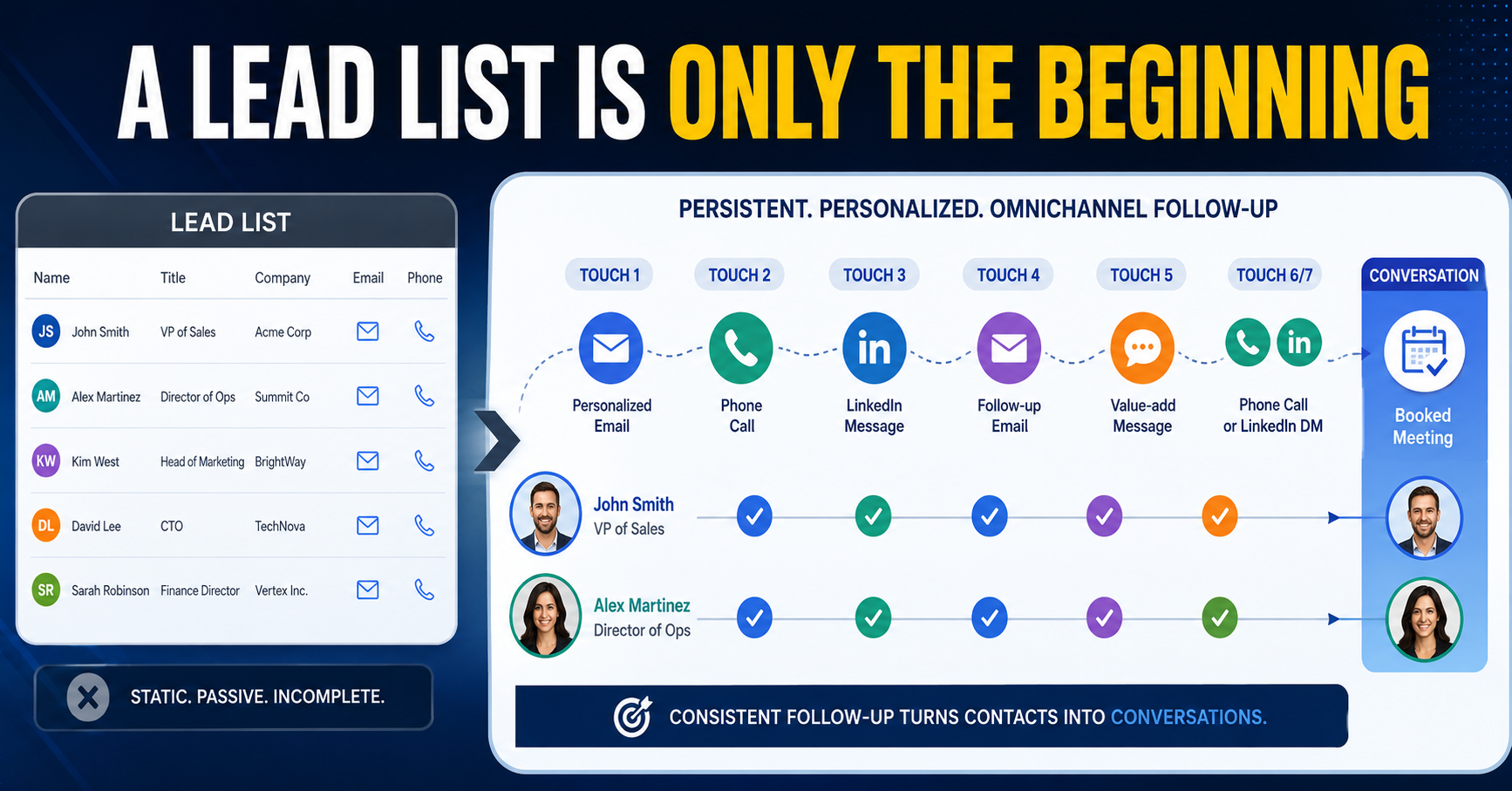
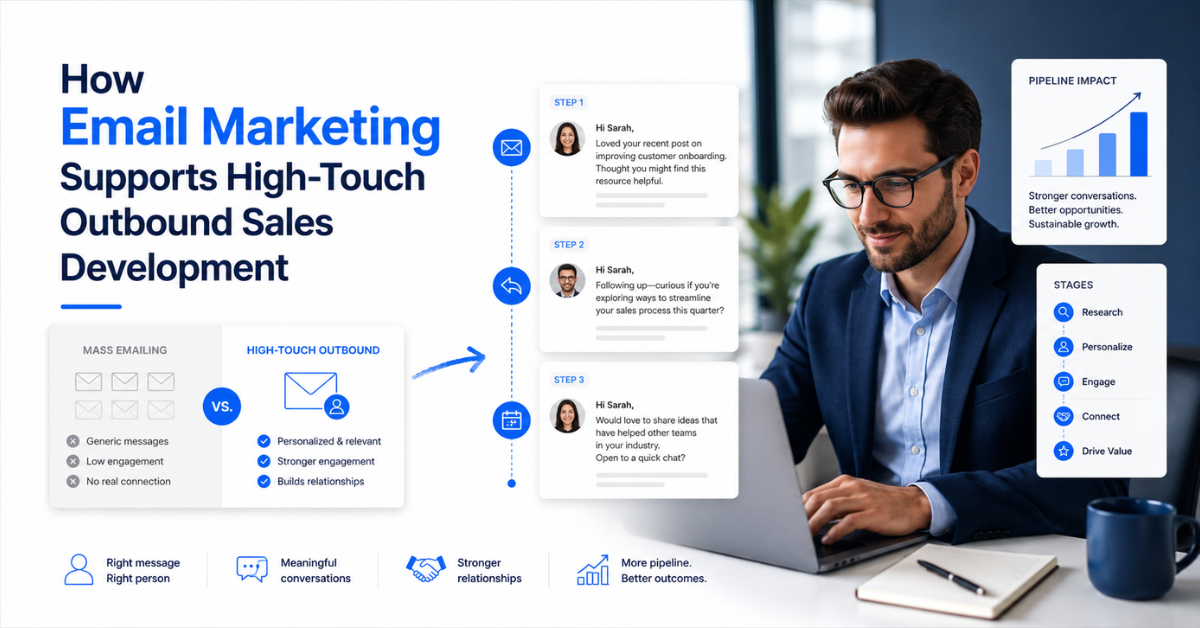
Email Marketing should not be treated as a mass-blast channel. Salaria Sales helps B2B teams use email as part of a high-touch outbound strategy that creates trust, starts conversations, and supports qualified pipeline growth.
Email Marketing remains one of the most important channels in outbound sales development, but the way businesses use it has changed. Buyers no longer respond well to generic blasts, weak templates, or repetitive follow-ups that offer no real value. In complex B2B sales, email works best when it supports a high-touch outbound strategy built around relevance, research, and buyer context. The goal is not to send as many emails as possible. The goal is to create meaningful engagement with the right prospects at the right time. Email can introduce a business problem, reinforce a cold call, support LinkedIn outreach, nurture prospects, and prepare buyers for a qualified sales conversation. When combined with SDR outsourcing and a Human-AI Sales Approach, Email Marketing becomes a powerful tool for scalable personalization. It helps businesses improve B2B lead generation, strengthen pipeline quality, and create better conversations throughout the buyer journey.
What Is Email Marketing in Outbound Sales Development
Email Marketing in outbound sales development is the strategic use of personalized, targeted email communication to engage potential buyers, create interest, support follow-up, and move prospects toward qualified sales conversations.
1. Email Marketing Is More Than Sending Campaigns
Email Marketing is often misunderstood as a simple campaign activity where teams send messages to large contact lists. In high-touch outbound, email has a more strategic role. It helps create awareness, communicate relevance, introduce value, and support multi-channel engagement. A good outbound email should make the buyer understand why the message matters to them. When email is treated as a conversation starter rather than a mass broadcast, it becomes much more effective.
2. Email Supports the Buyer Journey
B2B buyers rarely become ready for a meeting after one touchpoint. They may need multiple interactions before they understand the problem, trust the sender, or agree to a conversation. Email helps support this journey by delivering relevant messages at different stages of buyer awareness. Early emails may introduce a challenge, while later emails may offer insight, proof, or a reason to reconnect. This makes Email Marketing valuable for both prospecting and nurturing.
3. Email Helps SDRs Create Context Before Calls
Cold calling becomes stronger when prospects have already received a relevant email. The email gives SDRs a point of reference and makes the call feel less random. A prospect may not reply immediately, but they may recognize the company name or remember the topic when the SDR calls. This creates warmer context for the conversation. In a high-touch outbound strategy, email and phone work together rather than competing for attention.
4. Email Marketing Helps Scale Personalized Outreach
Personalization is essential in modern B2B lead generation, but it can be difficult to scale without process and technology. Email allows SDR teams to personalize at the account, role, industry, and pain point level. A Human-AI Sales Approach can support research and segmentation while human SDRs refine the message and tone. This creates outreach that is both efficient and relevant. Scaled personalization is one of the biggest advantages of modern outbound Email Marketing.
Why High-Volume Email Blasts Are Losing Effectiveness
High-volume email blasts may create activity, but they often fail to create meaningful pipeline. Modern buyers are more selective and more likely to ignore outreach that feels generic or irrelevant.
1. Buyers Receive Too Many Generic Emails
Most B2B decision-makers receive a large number of sales emails every week. Many of these messages sound similar, use generic claims, and fail to connect to the buyer’s real priorities. This makes buyers quick to delete or ignore emails that do not feel relevant. High-volume blasts often add to this noise rather than standing out from it. High-touch Email Marketing performs better because it gives the buyer a clear reason to pay attention.
2. Mass Emails Can Damage Brand Perception
Every email shapes how prospects view your company. If buyers receive irrelevant or repetitive messages, they may associate the brand with low-quality outreach. This can hurt trust before a real sales conversation ever happens. In complex B2B sales, trust and professionalism matter because buying decisions carry more risk. Thoughtful email outreach protects brand reputation by showing preparation and respect for the buyer’s time.
3. Low Engagement Can Hurt Deliverability
Email deliverability is an important part of outbound performance. If campaigns generate low opens, low replies, unsubscribes, or spam complaints, future emails may become less likely to reach the inbox. High-volume email blasts often increase this risk because they target broad audiences with weak relevance. High-touch outbound reduces deliverability risk by focusing on better-fit prospects and more relevant messaging. Better engagement supports better long-term email performance.
4. Volume Metrics Can Hide Poor Pipeline Quality
A campaign may send thousands of emails and generate some replies, but that does not mean it is creating quality pipeline. The real question is whether replies turn into qualified meetings, opportunities, and revenue. High-volume email programs often produce weak-fit leads that waste SDR and account executive time. Businesses should measure Email Marketing by pipeline contribution, not just send volume. Quality-focused metrics create better sales development behavior.
How Email Marketing Supports High-Touch Outbound
High-touch outbound uses email as part of a coordinated sales development strategy. Each email should support relevance, timing, trust, and movement toward a meaningful conversation.
1. Email Introduces the Business Problem
A strong outbound email does not start with a long product pitch. It starts with a problem the buyer may recognize. This could be a challenge related to pipeline quality, sales productivity, lead conversion, buyer engagement, or outbound performance. When the email is problem-led, it feels more relevant to the prospect. This creates curiosity and gives the buyer a reason to continue the conversation.
2. Email Reinforces Multi-Channel Outreach
Email works best when combined with cold calling, LinkedIn engagement, voicemail, and structured follow-up. A buyer may ignore one channel but respond through another. Email can introduce the topic before a call or summarize the reason for outreach after a LinkedIn interaction. This creates a more connected buyer experience. Multi-channel outreach helps prospects recognize the message and engage when the timing is right.
3. Email Helps Nurture Not-Ready Buyers
Not every prospect is ready to book a meeting immediately. Some buyers may be interested but need more time, internal alignment, or education. Email Marketing helps nurture these prospects with relevant follow-ups, useful insights, and clear next steps. This keeps the relationship active without forcing a premature sales conversation. Strong nurturing turns future interest into future pipeline.
4. Email Creates a Written Record of Value
Unlike a phone call, an email gives prospects something they can revisit, forward, or share internally. This is useful in complex B2B sales where multiple stakeholders may influence the buying process. A clear email can help explain the business issue, summarize the value proposition, and frame the next step. This makes email an important tool for internal buyer conversations. Well-written email outreach can support stakeholder education before the first meeting.
What Makes High-Touch Email Marketing Different
High-touch Email Marketing is different from mass email outreach because it prioritizes relevance, research, personalization, and buyer readiness.
1. It Starts With a Strong Ideal Customer Profile
A high-touch email strategy begins with knowing who should receive the message. The Ideal Customer Profile should define the right industries, company sizes, buyer roles, pain points, and buying triggers. Without a clear ICP, email outreach becomes broad and ineffective. Strong targeting helps SDR teams focus on buyers who are more likely to care. Better targeting leads to better engagement and stronger pipeline quality.
2. It Uses Buyer Context
High-touch Email Marketing uses context to make each message more relevant. Context may include company growth, market changes, hiring activity, technology usage, role responsibilities, or previous engagement. The email does not need to include every detail, but it should show a thoughtful reason for outreach. Buyer context helps the message feel specific rather than automated. This increases trust and improves response rates.
3. It Focuses on the Prospect’s Problem
Many outbound emails fail because they focus too much on the seller’s service. High-touch emails focus on the buyer’s likely problem and the business outcome connected to solving it. This makes the message more useful and easier to understand. Prospects are more likely to engage when they see their own challenge reflected in the outreach. Problem-led messaging creates stronger sales conversations.
4. It Creates a Clear and Low-Friction Next Step
The best outbound emails do not overwhelm buyers with too many requests. They create a simple next step, such as a short conversation, a quick reply, or a relevant follow-up. The ask should match the buyer’s stage in the journey. A cold prospect may not be ready for a long demo, but they may be open to a focused conversation. Clear next steps make it easier for prospects to engage.
The Role of Email Marketing in B2B Lead Generation
Email Marketing supports B2B lead generation by helping businesses identify interest, create engagement, and move prospects toward qualification.
1. Email Helps Identify Engaged Prospects
Email engagement can reveal which prospects may be more interested or active. Opens, replies, clicks, and follow-up interactions can help SDR teams prioritize outreach. These signals should not be treated as perfect indicators, but they can guide next steps. When email engagement is combined with cold calling and LinkedIn activity, sales teams gain a clearer view of prospect interest. This helps improve lead prioritization.
2. Email Improves Lead Qualification
Email conversations can help SDR teams understand whether a prospect is a fit. A reply may reveal timing, need, objections, or the right person to contact. Even a negative response can provide useful information for segmentation and future outreach. Email gives SDRs a way to begin qualification before a meeting is booked. Better qualification leads to better appointment setting.
3. Email Helps Move Prospects Through the Funnel
Different emails can support different stages of the funnel. Early emails introduce the problem, middle-stage emails build credibility, and later emails invite a more direct conversation. This progression helps prospects become more familiar with the company and the value proposition. It also allows SDR teams to engage without relying on one aggressive message. Funnel-based email strategy improves buyer experience.
4. Email Supports Account-Based Outreach
In complex B2B sales, multiple people inside one account may be involved in a buying decision. Email can help engage different stakeholders with role-specific messaging. A finance leader may care about cost efficiency, while a sales leader may care about pipeline productivity. Account-based email outreach improves relevance across the buying committee. This supports stronger outbound sales development and higher-quality opportunities.
The Role of a Human-AI Sales Approach in Email Marketing
A Human-AI Sales Approach helps businesses scale high-touch Email Marketing without losing personalization or human judgment. AI supports research and efficiency, while SDRs create relevance and relationship-building.
1. AI Helps With Research and Segmentation
AI can help analyze account data, identify patterns, and organize prospects into meaningful segments. This makes it easier to create targeted email campaigns based on industry, role, pain point, or buyer intent. AI can also help summarize company information and surface useful signals. However, human SDRs still need to decide which insights are meaningful. Good segmentation requires both data and judgment.
2. AI Supports Personalization at Scale
Personalization can be time-consuming when done manually for every prospect. AI can help speed up research and suggest relevant talking points. Human SDRs can then refine the message so it sounds natural and buyer-focused. This balance allows teams to personalize more emails without sounding robotic. A Human-AI Sales Approach improves efficiency while protecting quality.
3. Human SDRs Protect Tone and Relevance
AI can support email creation, but human SDRs should guide tone, positioning, and buyer relevance. Buyers can often tell when messages are generic or overly automated. Human review ensures the email feels professional, concise, and appropriate for the prospect. This is especially important in complex sales where brand trust matters. The human element helps convert data into meaningful communication.
4. Human-AI Feedback Improves Campaign Performance
Email Marketing improves when teams analyze performance and adjust. AI and analytics can show which subject lines, messages, segments, and cadences perform best. Human SDRs and sales leaders can interpret the results based on buyer conversations and campaign goals. This creates a continuous improvement system. Over time, the Human-AI Sales Approach helps improve response rates, meeting quality, and pipeline contribution.
Best Practices for High-Touch Email Marketing
High-touch Email Marketing requires structure and discipline. These best practices help businesses create more relevant outreach and stronger sales conversations.
1. Write Short, Clear Emails
B2B buyers do not have time to read long sales pitches. A strong email should quickly explain why you are reaching out, what problem may matter, and what next step makes sense. Clarity is more important than cleverness. Short emails are easier to read and easier to reply to. The best messages respect the buyer’s time.
2. Use Role-Specific Messaging
Different buyer roles care about different outcomes. A CEO may focus on growth, a CRO may focus on pipeline, and a sales operations leader may focus on process efficiency. Role-specific messaging helps the buyer understand why the email matters to them. It also shows that the sender understands the prospect’s responsibilities. This makes outreach more relevant and effective.
3. Build Follow-Up Sequences That Add Value
Follow-up should not repeat the same message again and again. Each follow-up should add a new angle, insight, question, or reason to reconnect. This keeps the sequence useful and prevents buyer fatigue. Strong follow-up also helps nurture prospects who are interested but not ready. A good sequence creates momentum without being pushy.
4. Connect Email With Calling and LinkedIn
Email should be part of a multi-channel outbound system. Calls can create direct conversation, LinkedIn can build familiarity, and email can provide written context. When these channels work together, the buyer experience becomes more coherent. SDRs should coordinate touchpoints rather than treating each channel separately. Multi-channel consistency improves engagement and conversion.
Common Mistakes in Outbound Email Marketing
Many businesses weaken their Email Marketing results by relying on outdated tactics. Avoiding these mistakes can improve buyer experience and pipeline quality.
1. Sending Generic Messages to Broad Lists
Generic messages sent to broad lists are easy to ignore. They usually fail because they do not connect to the buyer’s specific role, company, or challenge. This reduces response rates and can damage sender reputation. High-touch outbound requires more focused targeting and stronger personalization. Better relevance creates better engagement.
2. Making the Email Too Seller-Focused
Many outbound emails talk too much about the company, product, or service. Buyers care more about their own priorities and problems. A better email should connect the outreach to a relevant business outcome. The message should make the buyer feel understood before asking for a meeting. Buyer-focused messaging is more effective than seller-focused promotion.
3. Using Weak or Confusing Calls to Action
Some emails fail because the next step is unclear or too demanding. Asking for too much too soon can reduce replies. A good next step should be simple, specific, and appropriate for the buyer’s stage. This might be a short call, a quick reply, or confirmation of the right person. Clear asks improve response rates.
4. Ignoring Deliverability and Engagement Quality
Even strong messaging can fail if emails do not reach the inbox. Teams should pay attention to deliverability, sender reputation, list hygiene, bounce rates, and engagement signals. High-volume, low-quality outreach can reduce deliverability over time. High-touch Email Marketing protects performance by focusing on better targeting and better engagement. Healthy deliverability supports long-term outbound success.
How to Measure Email Marketing Success in High-Touch Outbound
Email Marketing should be measured by its contribution to sales conversations and pipeline, not just by activity metrics.
1. Response Quality
A high reply rate is useful only if the replies are meaningful. Teams should evaluate whether responses come from the right buyers and whether they indicate interest, timing, or useful referral information. Response quality helps measure whether the message is reaching the right audience. A smaller number of strong replies is often more valuable than many weak responses. Quality matters more than volume.
2. Meetings Booked From Email Engagement
Email can directly support appointment setting by creating interest and prompting prospects to schedule conversations. Businesses should track how many qualified meetings are influenced or generated by email. This helps connect Email Marketing to outbound sales development outcomes. The best measurement looks beyond booked meetings and evaluates meeting quality. Sales-ready meetings are the real goal.
3. Meeting-to-Opportunity Conversion
If email-driven meetings do not become opportunities, the targeting or messaging may need improvement. Meeting-to-opportunity conversion helps determine whether email outreach is attracting the right prospects. A strong conversion rate suggests that email is supporting quality pipeline. A weak rate may indicate broad targeting or poor qualification. This metric connects email performance to revenue potential.
4. Pipeline Contribution
Pipeline contribution measures how much qualified pipeline is influenced by Email Marketing. This is one of the most important metrics for high-touch outbound. It shows whether email is helping create real sales opportunities, not just engagement. Pipeline contribution helps leadership understand the business value of email outreach. Strong Email Marketing should support measurable revenue outcomes.
Services Provided by Salaria Sales
Salaria Sales helps businesses use Email Marketing as part of a high-touch outbound sales development strategy that creates better conversations and stronger pipeline. As a Full-Service B2B Sales & SDR Outsourcing Agency, Salaria Sales combines SDR outsourcing, B2B lead generation, cold calling, personalized email outreach, LinkedIn engagement, appointment setting, prospect research, and campaign optimization into a complete growth system. The team works with clients to define the Ideal Customer Profile, identify target accounts, segment buyers, create relevant messaging, and execute multi-channel outreach. Salaria Sales uses a Human-AI Sales Approach to improve account research, buyer intent analysis, personalization, and performance reporting while keeping experienced human SDRs responsible for communication and qualification. This ensures email outreach is efficient without becoming generic or automated in a way that damages buyer trust. Clients benefit from stronger targeting, better email engagement, cleaner sales handoffs, and higher-quality meetings. Salaria Sales helps businesses move beyond mass email blasts and build email programs that support qualified pipeline growth.
If you want Email Marketing that supports high-touch outbound sales development and stronger B2B pipeline, book a meeting with the Salaria Sales team here: https://salariasales.com/book/
Conclusion
Email Marketing is still a powerful part of outbound sales development, but it must be used with strategy and precision. Generic email blasts are losing effectiveness because modern buyers expect relevance, context, and value. High-touch outbound uses email to support better conversations, not just higher send volume. It introduces business problems, reinforces cold calling, supports LinkedIn engagement, nurtures prospects, and helps prepare buyers for sales-ready meetings. A Human-AI Sales Approach makes this even stronger by combining AI-driven research and segmentation with human judgment, personalization, and relationship-building. Businesses that measure email by pipeline contribution instead of send volume will build stronger sales development systems. In modern B2B lead generation, email works best when it feels thoughtful, targeted, and connected to the buyer’s journey. The future of outbound Email Marketing is not more automation for its own sake. It is smarter outreach, better timing, and more meaningful buyer engagement.
Frequently Asked Questions (FAQs)
1. What is Email Marketing in outbound sales development?
Email Marketing in outbound sales development is the use of targeted and personalized emails to engage prospects, support follow-up, and create qualified sales conversations.
2. How does Email Marketing support high-touch outbound?
Email Marketing supports high-touch outbound by introducing value, reinforcing calls and LinkedIn outreach, nurturing prospects, and helping move buyers toward sales readiness.
3. Why are high-volume email blasts less effective today?
High-volume email blasts are less effective because buyers receive too many generic messages and are more likely to ignore outreach that lacks relevance or personalization.
4. What makes high-touch Email Marketing different?
High-touch Email Marketing focuses on targeted prospects, buyer context, personalized messaging, and meaningful follow-up rather than mass sending.
5. How does a Human-AI Sales Approach improve Email Marketing?
A Human-AI Sales Approach uses AI for research, segmentation, and insights while human SDRs create relevant messaging and manage buyer engagement.
6. How does Email Marketing help B2B lead generation?
Email Marketing helps B2B lead generation by creating engagement, identifying interested prospects, supporting qualification, and moving buyers toward meetings.
7. What metrics should businesses track for outbound Email Marketing?
Businesses should track response quality, qualified meetings, meeting-to-opportunity conversion, pipeline contribution, and revenue influence.
8. How can Salaria Sales help with Email Marketing?
Salaria Sales helps businesses create personalized email outreach as part of a multi-channel outbound strategy supported by SDR outsourcing and Human-AI execution.