A winning B2B Lead Generation Strategy is not built from a spreadsheet of contacts. Salaria Sales helps businesses move beyond lead lists with Human-AI prospecting, expert SDRs, and outreach that creates real pipeline.
Many companies still treat B2B lead generation as a list-building exercise. They purchase contact databases, upload names into outreach tools, and expect revenue to follow. But modern buyers are harder to reach, more selective, and less responsive to generic sales messaging. A successful B2B Lead Generation Strategy now requires more than access to names, emails, and job titles. It requires precise targeting, buyer insight, strong messaging, multi-channel engagement, and real human judgment. Lead lists may help identify potential contacts, but they do not explain whether those contacts are the right buyers, whether they have intent, or whether they are ready for a meaningful conversation. This is where modern outbound sales development has changed. Companies that combine accurate data with a Human-AI sales approach and skilled SDR execution are building stronger pipelines. In this article, we explain why lead lists are no longer enough and how businesses can build a smarter B2B Lead Generation Strategy that drives better meetings and revenue growth.
What Is a Modern B2B Lead Generation Strategy
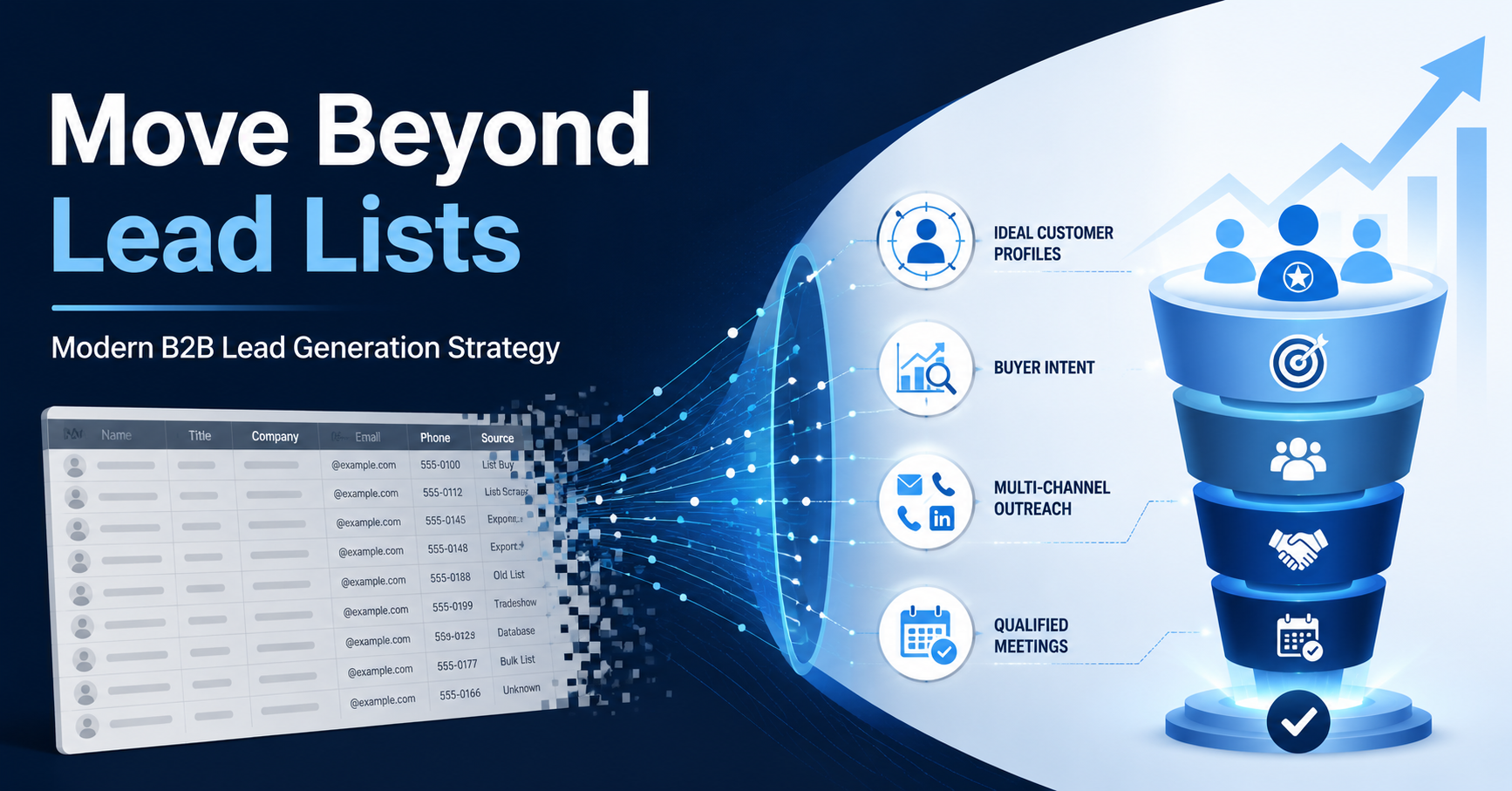
A modern B2B Lead Generation Strategy is a structured approach for identifying, engaging, qualifying, and converting high-fit business prospects into sales opportunities. It goes beyond collecting contact information and focuses on building a predictable pipeline through targeting, relevance, and buyer engagement.
1. Lead Generation Is More Than Contact Collection
Traditional B2B lead generation often starts and ends with a list of contacts. While contact data is useful, it is only one part of the sales development process. A name, title, email, and phone number do not tell you whether a prospect has a real business need or buying intent. Modern lead generation requires deeper research into the company, role, pain points, and market context. Without this additional layer of intelligence, outreach becomes generic and conversion rates remain low.
2. A Strong Strategy Connects Targeting to Revenue
A strong B2B Lead Generation Strategy connects prospecting activity directly to revenue outcomes. This means targeting accounts that match the Ideal Customer Profile and engaging decision-makers with relevant messaging. The goal is not simply to generate more leads but to create better opportunities. Sales teams need prospects who are qualified, reachable, and aligned with the solution being offered. When targeting is connected to revenue potential, pipeline quality improves and sales teams waste less time on poor-fit leads.
3. Modern Buyers Expect Relevance
B2B buyers are exposed to high volumes of outreach every day. Generic messaging is easy to ignore because it does not speak to the buyer’s specific situation. Modern buyers expect sales teams to understand their industry, challenges, and business priorities before reaching out. A modern B2B Lead Generation Strategy must therefore include personalization and value-driven communication. The more relevant the outreach, the more likely it is to create engagement and trust.
4. Lead Generation Must Support the Buyer Journey
The buyer journey is no longer linear. Prospects may research solutions independently, compare vendors, consume content, and delay conversations until they feel ready. A strong lead generation strategy supports this journey by matching outreach to the buyer’s stage of awareness. Some prospects need education, while others are ready for a meeting. Understanding this difference helps SDR teams create more useful conversations and improve appointment setting outcomes.
Why Lead Lists Alone No Longer Work
Lead lists can provide a starting point, but they cannot replace strategy. Businesses that depend too heavily on lists often struggle with poor engagement, low conversion rates, and weak pipeline quality.
1. Lead Lists Often Lack Context
Most lead lists provide basic contact data but little strategic context. They may include job titles, company names, and emails, but they often fail to show whether a prospect is relevant, active, or ready to engage. Sales teams need context such as business challenges, buying triggers, company growth signals, and role responsibilities. Without this context, outreach feels disconnected from the prospect’s reality. This leads to lower response rates and weaker sales conversations.
2. Contact Data Can Become Outdated Quickly
B2B data changes constantly as employees move roles, companies restructure, and responsibilities shift. A lead list that looks accurate today may become outdated within months. Sales teams that rely on stale data often contact the wrong people or waste time chasing inactive accounts. This damages productivity and reduces confidence in the sales process. A better approach combines data validation, manual research, and Human-AI analysis to keep prospecting accurate.
3. Lists Do Not Reveal Buyer Intent
A lead list cannot tell you whether a prospect is actively researching solutions or experiencing a pain point that your company can solve. Buyer intent is critical because timing plays a major role in outbound sales development. Reaching the right person at the wrong time can still lead to poor results. Intent-based prospecting helps businesses prioritize prospects who are showing signs of interest or market readiness. This makes outreach more relevant and improves meeting quality.
4. Lead Lists Encourage Volume-Based Outreach
When businesses rely heavily on lists, they often default to high-volume outreach. This can lead to generic emails, repetitive cold calls, and poor buyer experiences. Volume alone does not create pipeline quality. In many cases, it creates noise, low response rates, and brand damage. A modern B2B Lead Generation Strategy must move from list volume to prospect relevance.
What Modern B2B Lead Generation Should Include Instead
A better B2B Lead Generation Strategy combines data, research, human insight, and structured outbound execution. This approach helps businesses identify the right prospects and engage them in ways that create meaningful pipeline opportunities.
1. A Clearly Defined Ideal Customer Profile
A strong Ideal Customer Profile defines the companies most likely to benefit from your solution and become successful customers. It should include firmographic data, industry focus, company size, buyer roles, pain points, technology usage, and buying triggers. A clear ICP helps SDR teams prioritize the right accounts and avoid wasting effort on poor-fit prospects. It also improves messaging because the outreach is built around real buyer needs. Businesses that refine their ICP often see stronger engagement and higher conversion rates.
2. Deeper Prospect Research
Modern prospecting requires more than pulling names from a database. SDR teams should research company priorities, recent announcements, leadership changes, hiring trends, and operational challenges. This information helps create outreach that feels specific and valuable. Deeper research also allows sales teams to identify the best entry points within an organization. When prospect research is done well, outreach becomes more relevant and conversations become more productive.
3. Intent-Based Targeting
Intent-based targeting helps businesses identify prospects who are more likely to engage based on behavior and signals. These signals may include website activity, content engagement, category interest, funding events, expansion signals, or hiring patterns. Intent data helps sales teams prioritize outreach and improve timing. Instead of contacting everyone on a list, SDR teams focus on accounts showing signs of interest or readiness. This improves efficiency and strengthens pipeline quality.
4. Multi-Channel Outbound Sales Development
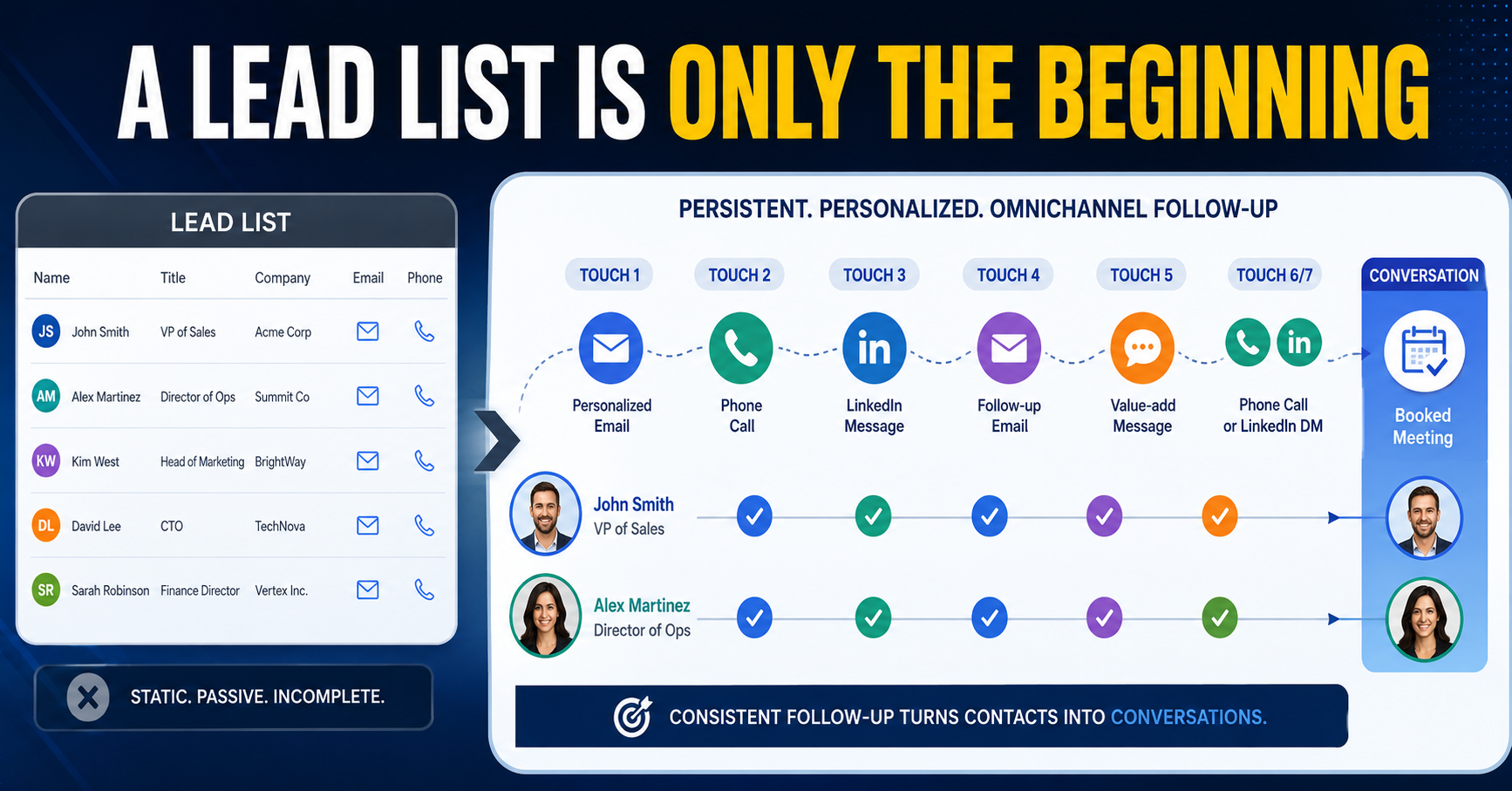
Modern B2B buyers do not engage through one channel only. A strong outbound sales development strategy combines email, cold calling, LinkedIn outreach, and follow-up sequences. Multi-channel outreach increases visibility and gives prospects more ways to respond. The key is consistency across channels without sounding repetitive or automated. When each touchpoint adds value, prospects are more likely to engage and move toward a sales conversation.
The Role of the Human-AI Sales Approach in Lead Generation
The Human-AI sales approach helps businesses scale prospecting while preserving personalization, quality, and buyer relevance. It uses technology where it adds value and human expertise where judgment and communication matter most.
1. AI Helps Improve Research and Targeting
AI can help analyze large amounts of prospect and account data faster than manual research alone. It can identify patterns, prioritize accounts, and surface signals that may indicate buying interest. This improves efficiency and helps SDR teams focus on higher-value prospects. However, AI should not be used as a replacement for human judgment. The best results come when AI supports research and targeting while humans validate insights and shape outreach strategy.
2. Human SDRs Create Real Conversations
B2B lead generation still depends on trust, empathy, and strong communication. Human SDRs understand tone, context, objections, and buyer hesitation in ways automation cannot fully replicate. They can adapt during conversations, ask follow-up questions, and build rapport with decision-makers. This is especially important in complex B2B sales where prospects need confidence before agreeing to a meeting. Human expertise turns prospect data into meaningful engagement.
3. Automation Should Support, Not Replace, Personalization
Automation can help with repetitive tasks such as data organization, workflow reminders, and sequence management. But when automation controls the entire prospecting process, outreach often becomes generic and ineffective. A Human-AI sales approach uses automation to improve productivity while keeping personalization at the center. This allows businesses to scale without sacrificing quality. The result is smarter outreach that feels relevant rather than robotic.
4. Human-AI Lead Generation Improves Pipeline Quality
Combining AI insights with SDR expertise improves the quality of opportunities entering the pipeline. AI helps identify potential fit and timing, while SDRs qualify interest and build relationships. This reduces low-quality meetings and improves conversion potential. Businesses using a Human-AI sales approach can generate more targeted conversations and make better use of sales resources. Better pipeline quality leads to stronger forecasting and more predictable revenue growth.
Common Mistakes in B2B Lead Generation Strategy
Many companies struggle with lead generation because they focus on activity instead of quality. Avoiding these common mistakes can significantly improve outbound performance.
1. Buying Lists Without a Clear Strategy
Buying lead lists without a clear ICP or outreach strategy often creates poor results. A list may contain thousands of contacts, but that does not mean those contacts are relevant. Without proper segmentation, messaging becomes too broad and difficult to personalize. This leads to low response rates and wasted SDR effort. Lead lists should only be used as one input within a broader strategy, not as the strategy itself.
2. Measuring Success Only by Lead Volume
Lead volume can be misleading if the leads are not qualified. Many businesses celebrate large numbers of leads while ignoring conversion rates, meeting quality, and pipeline contribution. This creates a false sense of progress. A better measurement framework includes qualified meetings, opportunity creation, sales acceptance, and revenue impact. Quality-focused metrics help teams understand whether their lead generation strategy is actually working.
3. Ignoring Sales and Marketing Alignment
B2B lead generation works best when sales and marketing teams agree on the ICP, messaging, and qualification standards. Misalignment creates friction and reduces lead quality. Marketing may generate leads that sales does not value, while sales may ignore useful engagement signals. A shared strategy ensures that both teams work toward the same revenue goals. Alignment improves buyer experience and increases conversion rates.
4. Overlooking Follow-Up and Lead Nurturing
Many leads are not ready to convert immediately. Businesses that fail to nurture prospects often lose opportunities that could become valuable later. Follow-up should be structured, relevant, and based on the prospect’s stage in the buyer journey. SDR teams should provide useful information, ask thoughtful questions, and maintain engagement over time. Strong nurturing helps move prospects from awareness to sales readiness.
How to Build a Better B2B Lead Generation Strategy
A stronger B2B Lead Generation Strategy starts with clarity, precision, and consistent execution. The goal is to create a repeatable system that generates qualified pipeline, not just contact activity.
1. Start With Your Best Customers
The best way to define your future prospects is to study your current best customers. Identify what they have in common, including company size, industry, challenges, buying triggers, and decision-making structure. This helps create a more accurate ICP. When your outreach is modeled around customers who already succeed with your solution, lead quality improves. This also gives SDR teams better messaging based on proven value.
2. Segment Your Target Market
Not every prospect should receive the same message. Segmenting your target market allows you to tailor outreach based on industry, role, company stage, or pain point. This improves relevance and engagement. Segmentation also helps sales teams prioritize accounts based on potential value and readiness. A segmented strategy is far more effective than one-size-fits-all outreach.
3. Use Data to Guide Prioritization
Data should help sales teams decide where to focus their time. This includes intent data, engagement signals, CRM history, firmographics, and account research. Prioritization ensures SDRs spend more time on prospects with stronger potential. It also improves productivity by reducing wasted outreach. Data-driven prioritization is a key part of modern outbound sales development.
4. Build Feedback Loops Between SDRs and Sales Teams
A successful lead generation strategy improves over time through feedback. SDRs should share what they are hearing from prospects, while account executives should report which meetings convert into real opportunities. This feedback helps refine targeting, messaging, and qualification criteria. Without feedback loops, teams repeat the same mistakes. Continuous learning makes lead generation more effective and scalable.
Services Provided by Salaria Sales
Salaria Sales helps businesses build a stronger B2B Lead Generation Strategy that goes beyond static lead lists and generic outreach. As a Full-Service B2B Sales & SDR Outsourcing Agency, Salaria Sales combines SDR outsourcing, outbound sales development, appointment setting, and B2B lead generation into a complete growth system. The team works with clients to define the right Ideal Customer Profile, identify high-value prospects, and create targeted outreach campaigns across email, cold calling, and LinkedIn. Salaria Sales uses a Human-AI sales approach to improve research, targeting, and campaign performance while keeping human expertise at the center of sales conversations. Instead of relying only on databases or automation, the team focuses on personalized engagement, strong qualification, and pipeline quality. Clients benefit from experienced SDR professionals who know how to turn prospect data into meaningful conversations. Salaria Sales also provides ongoing campaign optimization and reporting to help businesses improve conversion rates, meeting quality, and predictable revenue growth.
If you want to build a B2B Lead Generation Strategy that moves beyond lead lists and creates real sales opportunities, book a meeting with the Salaria Sales team here: https://salariasales.com/book/
Conclusion
Modern B2B lead generation can no longer depend on lead lists alone. While contact data still has value, it is not enough to create meaningful conversations or predictable revenue. Businesses need a strategy that combines accurate targeting, buyer insight, personalized outreach, and strong SDR execution. A successful B2B Lead Generation Strategy focuses on quality, relevance, and sales readiness rather than raw contact volume. The Human-AI sales approach makes this possible by combining AI-driven research and prioritization with human judgment and authentic communication. Companies that move beyond static lists are better positioned to engage the right prospects, improve pipeline quality, and create stronger conversion outcomes. In a market where buyers are overwhelmed by generic outreach, relevance has become the new advantage. Businesses that build smarter lead generation systems will not only generate more qualified meetings but also create better buyer experiences and more sustainable growth.
Frequently Asked Questions (FAQs)
1. What is a B2B Lead Generation Strategy?
A B2B Lead Generation Strategy is a structured plan for identifying, engaging, qualifying, and converting business prospects into sales opportunities.
2. Why are lead lists not enough for B2B lead generation?
Lead lists provide contact data but often lack buyer intent, business context, qualification details, and personalization insights needed for effective outreach.
3. How can businesses improve B2B lead generation quality?
Businesses can improve quality by refining their ICP, using intent data, personalizing outreach, and combining AI insights with human SDR expertise.
4. What is the role of SDR outsourcing in lead generation?
SDR outsourcing provides experienced sales development professionals who handle prospecting, qualification, outreach, and appointment setting to build pipeline.
5. How does a Human-AI sales approach improve lead generation?
A Human-AI sales approach uses AI for research, targeting, and prioritization while human SDRs handle personalization, conversations, and relationship building.
6. What is outbound sales development?
Outbound sales development is the process of proactively reaching out to potential buyers through channels such as email, phone, and LinkedIn to create sales opportunities.
7. Why is pipeline quality more important than lead volume?
Pipeline quality matters because qualified prospects are more likely to convert into revenue, while high lead volume often creates wasted activity and poor sales outcomes.
8. How can Salaria Sales help with B2B lead generation?
Salaria Sales helps businesses improve targeting, personalize outreach, qualify prospects, and book better meetings through SDR outsourcing and outbound sales development.