
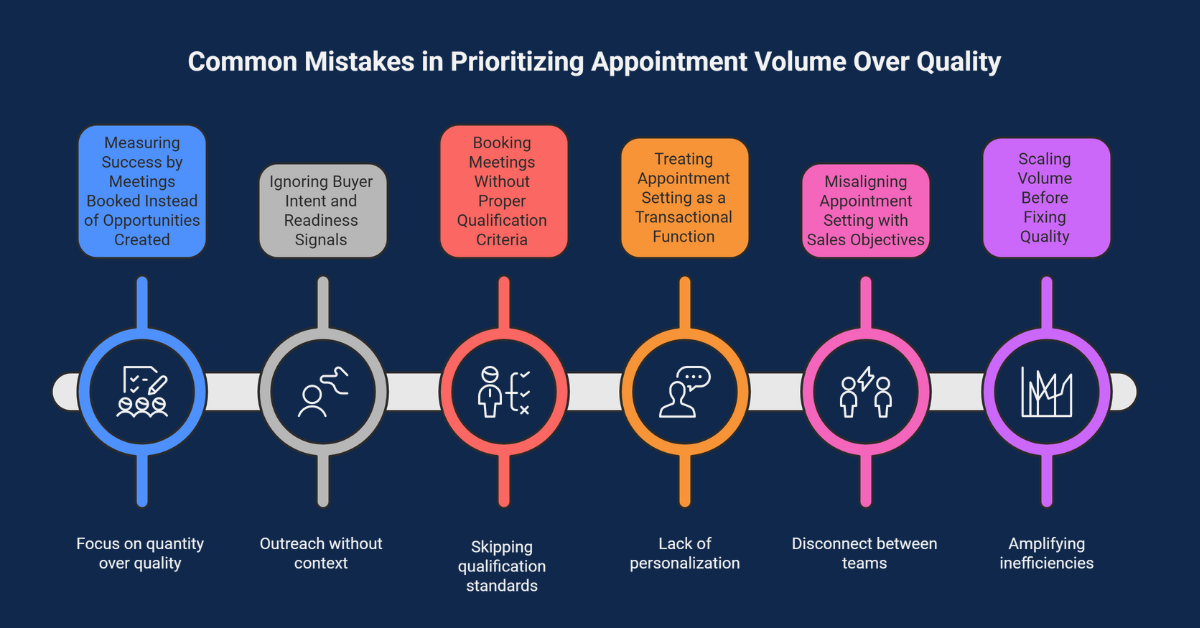
B2B appointment setting quality determines revenue outcomes. High volume meetings without intent, authority, or relevance inflate activity but silently destroy pipeline efficiency and sales confidence.
Many B2B teams believe that booking more meetings automatically leads to more revenue. This assumption often drives aggressive appointment setting strategies focused on volume metrics rather than buyer intent or qualification. While calendars may appear full, sales teams quickly discover that most meetings fail to progress into real opportunities. This gap between activity and revenue is one of the most common pipeline breakdowns in modern B2B sales.
B2B appointment setting quality plays a far greater role in revenue growth than raw meeting counts. Decision makers today expect relevance, context, and value before committing time. Meetings booked without alignment to buyer needs, authority, or timing lead to wasted sales hours, longer cycles, and declining close rates.
This article breaks down the six most costly mistakes companies make when prioritizing appointment volume over quality. It also explains how a quality first approach to B2B appointment setting creates stronger pipelines, better sales morale, and predictable revenue outcomes.
How Should Success Be Measured in B2B Appointment Setting: By Meetings Booked or Opportunities Created?
Success in B2B appointment setting should be measured by opportunity creation and progression, not just by the number of meetings booked. Many organizations judge performance by raw meeting counts, which rewards speed and volume over relevance and qualification. This often leads to teams filling calendars without validating fit or intent. High meeting counts can mask poor opportunity conversion rates, as sales teams attend calls with unqualified prospects lacking budget, authority, or urgency. This disconnect erodes trust between sales and appointment setting teams. When meetings consistently convert into qualified pipeline, sales teams engage more confidently and deals move faster, demonstrating true B2B appointment setting quality.
High meeting counts often mask poor opportunity conversion rates. Sales teams attend calls with unqualified prospects who lack budget, authority, or urgency. Over time, this disconnect erodes trust between sales and appointment setting teams.
B2B appointment setting quality should be measured by opportunity creation and progression. When meetings consistently convert into qualified pipeline, sales teams engage more confidently and deals move faster.
Why is Ignoring Buyer Intent and Readiness Signals a Mistake in B2B Appointment Setting?
Ignoring buyer intent and readiness signals is a mistake in B2B appointment setting because it leads to meetings booked too early or with no active interest, resulting in wasted time and stalled pipelines. Volume-driven strategies often overlook crucial buyer intent data, executing outreach at scale without considering where prospects are in their buying journey. Buyers who are not ready to engage view these meetings as interruptions, causing sales calls to stall quickly and follow-ups to go unanswered. This fills the pipeline with noise instead of momentum. High-quality B2B appointment setting, however, uses intent signals, engagement behavior, and contextual insights to time outreach correctly, ensuring meetings booked at the right moment convert at significantly higher rates.
Buyers who are not ready to engage view these meetings as interruptions rather than value driven conversations. Sales calls stall quickly, and follow ups go unanswered. The result is a pipeline filled with noise instead of momentum.
High quality B2B appointment setting uses intent signals, engagement behavior, and contextual insights to time outreach correctly. Meetings booked at the right moment convert at significantly higher rates.
What Happens When B2B Meetings Are Booked Without Proper Qualification Criteria?
When B2B meetings are booked without proper qualification criteria, sales teams spend valuable time discovering basic disqualifiers during live calls, leading to shorter conversations, lost credibility, and frustrated prospects. This is a costly mistake where qualification standards are removed to increase booking rates, often due to pressure on appointment setters. Criteria such as company size, use case fit, or decision-making authority are frequently skipped. Over time, sales productivity declines as reps spend more time qualifying than closing. Strong B2B appointment setting quality, however, relies on clear qualification frameworks, ensuring that when meetings meet defined criteria, sales conversations start at a higher level and progress faster toward revenue.
Sales teams then spend time discovering basic disqualifiers during live calls. This leads to shorter conversations, lost credibility, and frustrated prospects. Over time, sales productivity declines as reps spend more time qualifying than closing.
Strong B2B appointment setting quality relies on clear qualification frameworks. When meetings meet defined criteria, sales conversations start at a higher level and progress faster toward revenue.
What are the Consequences of Treating B2B Appointment Setting as a Transactional Function?
Treating B2B appointment setting as a transactional function damages brand perception, leads to lower show rates, and results in disengaged calls, ultimately providing sales teams with meetings of little context or value. High volume models often view appointment setting as a mere task rather than a strategic revenue function, characterized by rigid scripts, minimal personalization, and a focus on securing calendar slots instead of understanding buyer problems. While this approach may increase booking numbers, prospects feel rushed or misaligned. In contrast, quality-focused appointment setting positions conversations as consultative from the first touch, building trust before the sales call and increasing the likelihood of meaningful engagement.
This approach may increase booking numbers but damages brand perception. Prospects feel rushed or misaligned, leading to lower show rates and disengaged calls. Sales teams then inherit meetings with little context or value.
Quality focused appointment setting positions conversations as consultative from the first touch. This builds trust before the sales call and increases the likelihood of meaningful engagement.
What are the Impacts of Misaligning B2B Appointment Setting with Sales Objectives?
Misaligning B2B appointment setting with sales objectives causes a disconnect between booked meetings and what sales teams can realistically convert, leading to lengthened sales cycles and suffering forecasting accuracy. When appointment setting teams operate independently from sales goals, volume becomes the easiest metric to optimize. Sales leaders frequently report that meetings do not match target accounts, deal sizes, or pipeline priorities. However, B2B appointment setting quality significantly improves when teams are aligned to revenue goals, ideal customer profiles, and pipeline targets, as shared accountability ensures meetings support real business outcomes.
Sales leaders often report that meetings do not match target accounts, deal sizes, or pipeline priorities. As a result, sales cycles lengthen and forecasting accuracy suffers.
B2B appointment setting quality improves when teams are aligned to revenue goals, ideal customer profiles, and pipeline targets. Shared accountability ensures meetings support real business outcomes.
Why is Scaling B2B Appointment Volume Before Fixing Quality a Problem?
Scaling B2B appointment volume before fixing quality is a problem because it amplifies inefficiencies, accelerates pipeline decay, and increases costs without increasing revenue. Many companies attempt this by adding more outreach channels, data, and booking targets without improving qualification or messaging. This leads to sales teams burning out faster and leadership questioning the effectiveness of outbound efforts. High-performing teams, however, prioritize fixing quality first; once appointment conversion rates are strong, scaling volume becomes a growth lever rather than a risk.
This amplifies inefficiencies and accelerates pipeline decay. Sales teams burn out faster, and leadership questions the effectiveness of outbound efforts. Scaling broken processes only increases cost without increasing revenue.
High performing teams fix quality first. Once appointment conversion rates are strong, scaling volume becomes a growth lever rather than a risk.
Services Provided by Salaria Sales
Salaria Sales delivers B2B appointment setting services designed around quality, intent, and revenue outcomes. As a Full Service B2B Sales and SDR Outsourcing Agency, Salaria Sales focuses on building qualified pipeline, not vanity metrics.
Our appointment setting approach combines experienced human SDRs with a Human AI model that enhances research, targeting, and personalization. AI supports data enrichment, intent analysis, and message optimization, while human SDRs lead conversations with context and empathy.
We manage the entire appointment setting process end to end. This includes ideal customer profile definition, account selection, multi channel outreach, qualification frameworks, and sales handoff documentation. Every meeting is aligned with sales objectives and buyer readiness.
Salaria Sales operates on flexible engagement models that prioritize transparency and performance. Clients receive real time reporting on meeting quality, opportunity creation, and pipeline impact. This ensures appointment setting efforts directly support predictable revenue growth.
Conclusion
B2B appointment setting quality is one of the most underestimated drivers of revenue performance. While high meeting volume may look impressive on dashboards, it often hides deeper pipeline inefficiencies. Meetings that lack intent, fit, or authority drain sales resources and delay growth.
Companies that shift their focus from quantity to quality see immediate improvements in opportunity conversion, sales alignment, and deal velocity. Sales teams engage with confidence when meetings are meaningful and well qualified.
Prioritizing quality requires stronger qualification standards, better alignment with sales, and a consultative outreach approach. When appointment setting becomes a strategic revenue function rather than a volume driven activity, pipeline performance stabilizes and scales.
Organizations that invest in B2B appointment setting quality position themselves for sustainable growth rather than short term activity spikes.
Frequently Asked Questions
What is B2B appointment setting quality?
B2B appointment setting quality refers to how well meetings align with buyer intent, qualification criteria, and sales objectives. High quality meetings convert into pipeline and revenue at higher rates.
Why does appointment volume not equal revenue?
High meeting volume often includes unqualified or misaligned prospects. Without intent and fit, meetings stall and fail to progress into opportunities.
How do you measure appointment setting quality?
Quality is measured by opportunity creation, conversion rates, sales acceptance, and deal progression rather than raw meeting counts.
How can companies improve appointment setting quality?
Improvement comes from stronger qualification frameworks, intent driven targeting, sales alignment, and personalized outreach.
Is AI replacing human appointment setters?
No. The most effective models use a Human AI approach where AI supports research and insights while humans lead conversations and relationship building.