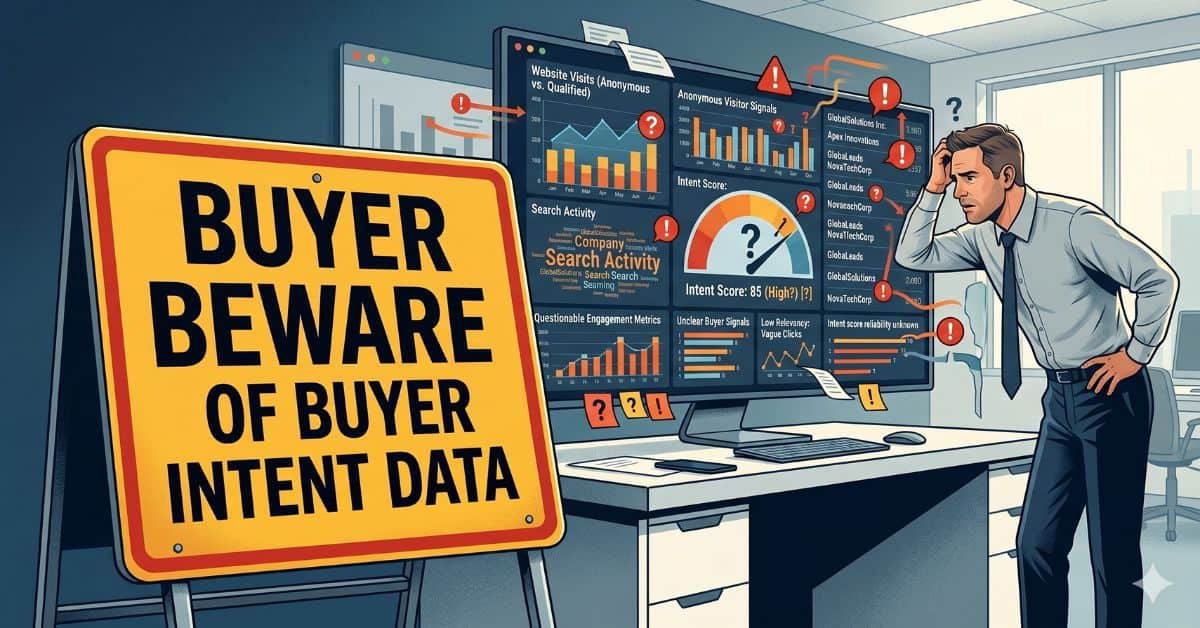
Buyer intent data is useful when it is treated as a signal. It becomes dangerous when sales teams treat it like certainty. Real intent still needs validation, context, and human judgment.
Buyer intent data sounds like the perfect answer to one of the hardest questions in sales.
Who is ready to buy?
That is what every sales leader wants to know. Which companies are actively looking? Which buyers are in-market? Who should the SDR team contact first? When is the right time to reach out? Which accounts deserve more attention, more follow-up, and more sales effort?
In a perfect world, buyer intent data would answer all of that. It would show the exact companies that are ready to buy. It would identify the right people inside those companies. It would tell the sales team when to reach out and what stage of the buying cycle the prospect is in.
That would be great.
But we do not live in that world.
The reality is much messier. Buyer intent data can be useful, but it is not magic. It can point sales teams in a better direction, but it cannot perfectly tell them who is ready to buy, who has budget, who has authority, or who is actually serious. The problem starts when companies treat intent data like the truth instead of treating it like one signal among many.
That is where buyer intent data becomes risky.
The Perfect Promise of Buyer Intent Data
The promise behind buyer intent data is easy to understand.
If a company is researching a topic, visiting certain pages, reading competitor comparisons, searching for category terms, or engaging with related content, then maybe they are in-market. Maybe they are exploring a problem. Maybe they are evaluating vendors. Maybe they are getting closer to a buying decision.
That logic makes sense.
Sales teams do not want to waste time calling the wrong accounts. Marketing teams do not want to spend budget on audiences that are not ready. Revenue teams want focus. They want to know where demand is forming before competitors get there.
That is why intent data is attractive.
In theory, it gives sales teams a shortcut to timing. Instead of reaching out cold with no context, they can prioritize accounts that appear to be showing interest. Instead of treating every lead the same, they can focus on the accounts that seem more active.
But the key phrase is “appear to be.”
Intent data can suggest interest. It does not always prove buying intent.
That distinction matters.
Why Real Buyer Intent Is Hard to Identify
Real buyer intent is difficult because buying behavior is rarely simple.
A company may research a topic for many reasons. Someone may visit your website because they are a student, job seeker, competitor, analyst, vendor, junior employee, or curious researcher. A person may search a category term because they are learning, not buying. A company may show activity without having budget, urgency, or decision-making alignment.
That does not mean the activity is useless. It means the activity needs interpretation.
This is where many intent data tools are overpromised. They make it sound as if the data can identify the perfect account at the perfect moment with the perfect buyer attached. That is rarely how it works in practice.
Intent is not a single event. It is a pattern. And even patterns can be misleading if they are not validated.
A few website visits do not automatically equal buying interest. A spike in research does not always mean an active deal cycle. A content download does not always mean executive priority. An anonymous company signal does not always tell you who to contact or whether anyone with authority is involved.
Sales teams need to be careful here.
If they treat every signal as proof, they will chase weak opportunities. If they ignore signals completely, they may miss useful indicators. The right answer is somewhere in the middle: use intent data, but do not worship it.
The Problem With Relying on One Intent Data Source
One of the biggest mistakes companies make is relying too heavily on one tool, one platform, or one signal.
No single intent source can give a complete picture of buyer readiness.
A website visitor tool may show that someone from a company viewed a page. A content platform may show category interest. A search signal may suggest research activity. A CRM may show past engagement. Email data may show clicks or replies. LinkedIn activity may show interaction. Sales calls may reveal direct pain or urgency.
Each of those signals tells part of the story. None of them tells the whole story alone.
This is why sales teams need layered validation.
Instead of saying, “This account visited our website, so they are ready to buy,” the better question is: “What other signals support this?”
Did they visit high-intent pages?
Did multiple people from the company engage?
Did someone with buying power interact?
Did they respond to outreach?
Did they download relevant content?
Did they view pricing, demo, service, or comparison pages?
Did the engagement continue over time?
The more signals that align, the stronger the case becomes.
Buyer intent should be built like evidence, not assumed from one data point.
Why Website Visits Do Not Always Equal Buying Intent
Website activity is one of the most common sources of intent data, but it is also one of the easiest to misread.
A company showing up in your website analytics can be interesting. It may be worth investigating. But it does not automatically mean the company is ready to buy. It may not even mean the right person visited.
This is a critical issue.
A low-level associate could be researching vendors for a basic internal task. An intern could be collecting information. A competitor could be looking at your positioning. Someone could have clicked accidentally. Someone could be browsing with no budget, no authority, and no immediate need.
If the sales team treats that activity as strong buying intent, they may over-prioritize the wrong accounts.
The same applies to search activity and anonymous engagement. A company may appear active around a topic, but activity alone does not show who is driving the research, what problem they are solving, or whether there is a real buying process underway.
This is why human judgment matters.
Intent data can say, “Look here.”
It cannot always say, “This person is ready to buy.”
That difference should shape how sales teams use the data.
Buying Power Matters More Than Anonymous Activity
One of the strongest points on buyer intent data is that buying power matters.
A signal is much more valuable when it points toward someone who can influence or make a decision. If the engagement is coming from people with no authority, no budget, and no connection to the buying committee, the data may create false excitement.
This happens often.
A company may appear active, but the people engaging may not be senior enough to matter. They may not own the problem. They may not be involved in vendor selection. They may not have the ability to move a conversation forward.
That does not make the account worthless. It means the signal needs to be handled carefully.
Sales teams should ask:
Who is likely behind the activity?
Does this company match our ideal customer profile?
Which decision-makers should we research?
Is there evidence of a business problem we can solve?
Is this activity connected to real buying authority?
Who else inside the account should we engage?
Intent data becomes far more useful when it is connected to account research and buying committee mapping. Without that, it can become a distraction.
The goal is not to chase every signal. The goal is to identify the right signals from the right accounts and connect them to the right people.
How to Validate Intent Across Multiple Signals
The strongest use of buyer intent data is not blind trust. It is structured validation.
Start with a broad pool of potential accounts that appear to show interest. Then narrow the focus based on additional engagement, account fit, and buying relevance. This is a much stronger approach than assuming one signal is enough.
For example, a company that visits your website once may be mildly interesting. A company that visits multiple service pages, has several people engaging, matches your ideal customer profile, interacts with outbound, and includes relevant decision-makers is much more interesting.
That is the difference between activity and validated intent.
Sales and marketing should work together here. Marketing can help identify patterns of engagement. Sales can test whether those patterns translate into real conversations. Outbound can be used not just to sell, but to learn. Who responds? Who ignores? Who forwards the message internally? Who takes a meeting? Who shows real pain?
That feedback loop is important.
Intent data should guide prioritization, but the market response should refine the strategy. The more a company engages across multiple stages, the more confidence the sales team can have.
That is how intent becomes useful.
Not as a magic answer, but as part of a system.
How Salaria Uses Buyer Intent Without Blindly Trusting It
At Salaria, we do not treat buyer intent data like a perfect solution. We treat it as one input in a smarter outbound process.
That distinction is important.
A lot of sales teams get too excited by intent dashboards. They see activity and assume opportunity. Our approach is more disciplined. We look at signals, but we also look at fit, buying power, account context, messaging relevance, and engagement across multiple touchpoints.
That means we do not blindly trust a single tool or data source. We layer signals. We research the account. We identify the right people. We test messaging. We study how prospects react. We refine based on actual response, not just assumed interest.
This is where human sales judgment matters.
AI and intent platforms can help point attention in the right direction. But humans still need to decide whether the signal is meaningful, whether the account is worth pursuing, and how the conversation should be approached.
That is how Salaria uses intent data responsibly. We do not ignore it, but we do not let it replace strategy.
Final Thoughts
So, does intent data actually work?
Yes, but only when it is used correctly.
Buyer intent data can help sales teams prioritize accounts, identify possible interest, and improve timing. But it should not be treated as certainty. It does not automatically reveal the perfect buyer. It does not guarantee readiness. It does not replace research, judgment, or real outbound execution.
The danger is not the data itself. The danger is believing the data knows more than it actually does.
The best sales teams in 2026 will use buyer intent data with discipline. They will validate signals across multiple sources. They will focus on buying power, not just anonymous activity. They will use engagement to narrow their focus. And they will rely on human judgment to turn signals into conversations.
Buyer intent data is useful when it helps you ask better questions.
It becomes dangerous when it convinces you that you already have all the answers.
Turn Buyer Signals Into Better Sales Conversations
Buyer intent data can point your team in the right direction, but it cannot replace strategy, research, and real sales judgment. Salaria helps B2B companies turn intent signals into smarter outbound campaigns by validating buyer interest, identifying the right decision-makers, and building outreach around real business context.
If your team wants to stop chasing weak signals and start creating better sales conversations, Salaria can help.