The future of sales development is not humans versus AI. It is humans using AI well. In 2026, the teams that win will be the ones that combine technology with judgment, not the ones trying to automate judgment away.
For a while, the pitch sounded simple.
Why hire SDRs when AI can do the work? Why invest in people when AI agents can prospect, write, personalize, follow up, and scale outreach without needing salaries, training, or management? For many companies, especially those excited by the latest wave of sales technology, that promise felt too tempting to ignore.
And for a while, the market leaned into it.
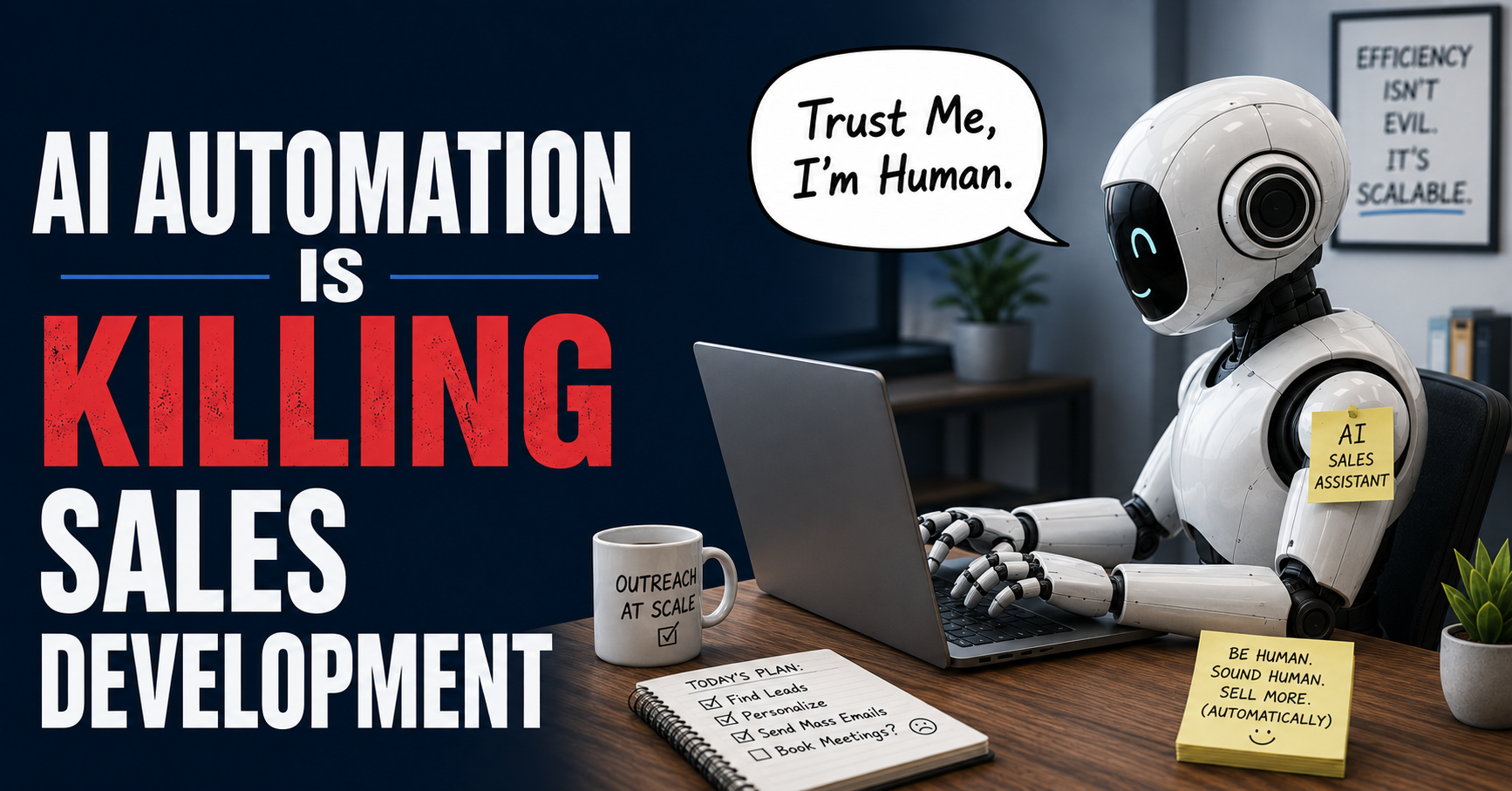
In 2023 and 2024, AI SDR companies pushed the idea hard. Some of them framed human sales talent as inefficient. Some made it sound like the answer to outbound sales was simply replacing the SDR team with AI. The message was bold, clean, and easy to sell. Stop hiring humans. Let the machines handle pipeline.
By 2026, that story looks far less convincing.
The market has now had time to test what fully automated outbound really produces. Companies have spent serious money on AI sales tools. They have tried AI prospecting, AI personalization, AI email creation, and AI-driven outbound workflows. In many cases, the results have not justified the promise. The tools may be impressive in a demo, but sales does not happen in a demo. Sales happens in messy, human, context-dependent environments where nuance matters.
That is why the real question in 2026 is no longer whether AI belongs in sales. It does. The real question is how it belongs.
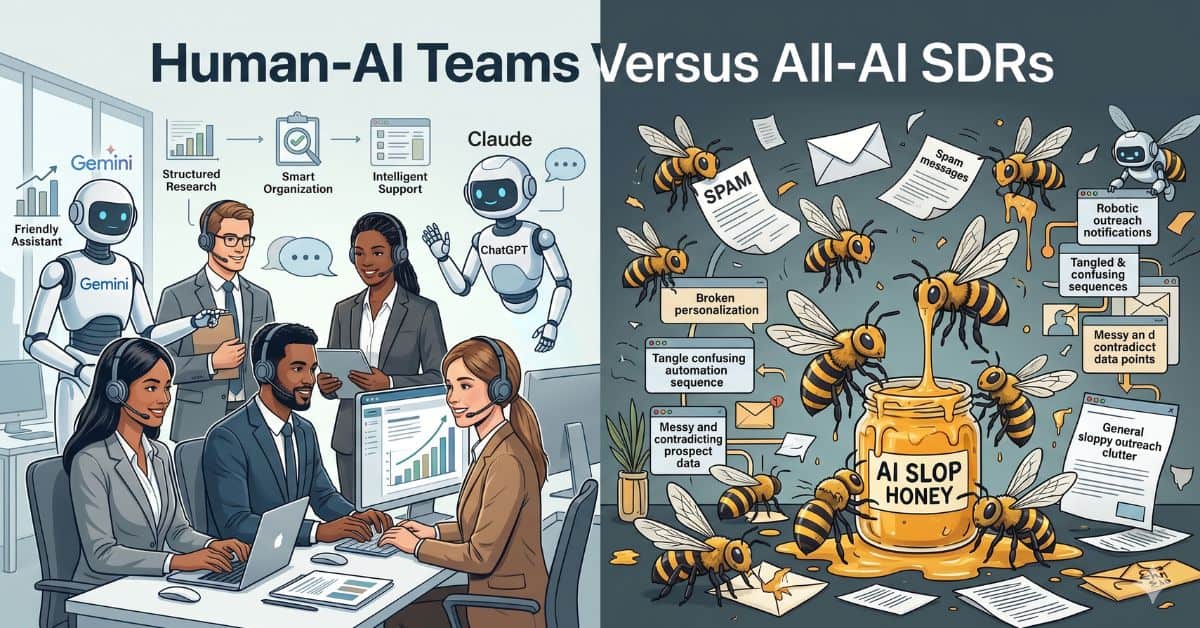
The best answer is not all-AI. It is Human-AI.
Why the All-AI SDR Pitch Was So Attractive
It is easy to understand why the all-AI SDR idea took off.
On the surface, it seems logical. Sales development involves repeatable tasks. Reps research companies. Reps look up contacts. Reps draft outreach. Reps follow up. Reps manage activity. Once you describe the work that way, it is not hard to imagine software doing all of it. For founders, operators, and engineering-minded leaders, the mental leap makes perfect sense.
If AI can write, summarize, organize, and automate, why not let it replace the SDR function entirely?
There is also an economic reason the pitch spread so quickly. The idea of reducing headcount while increasing output is powerful. Companies are always looking for efficiency. Agencies are always looking for margin. And software vendors are always looking for a category-defining message. “Replace SDRs with AI” checked all three boxes.
The problem is that the pitch made sales development sound more mechanical than it really is.
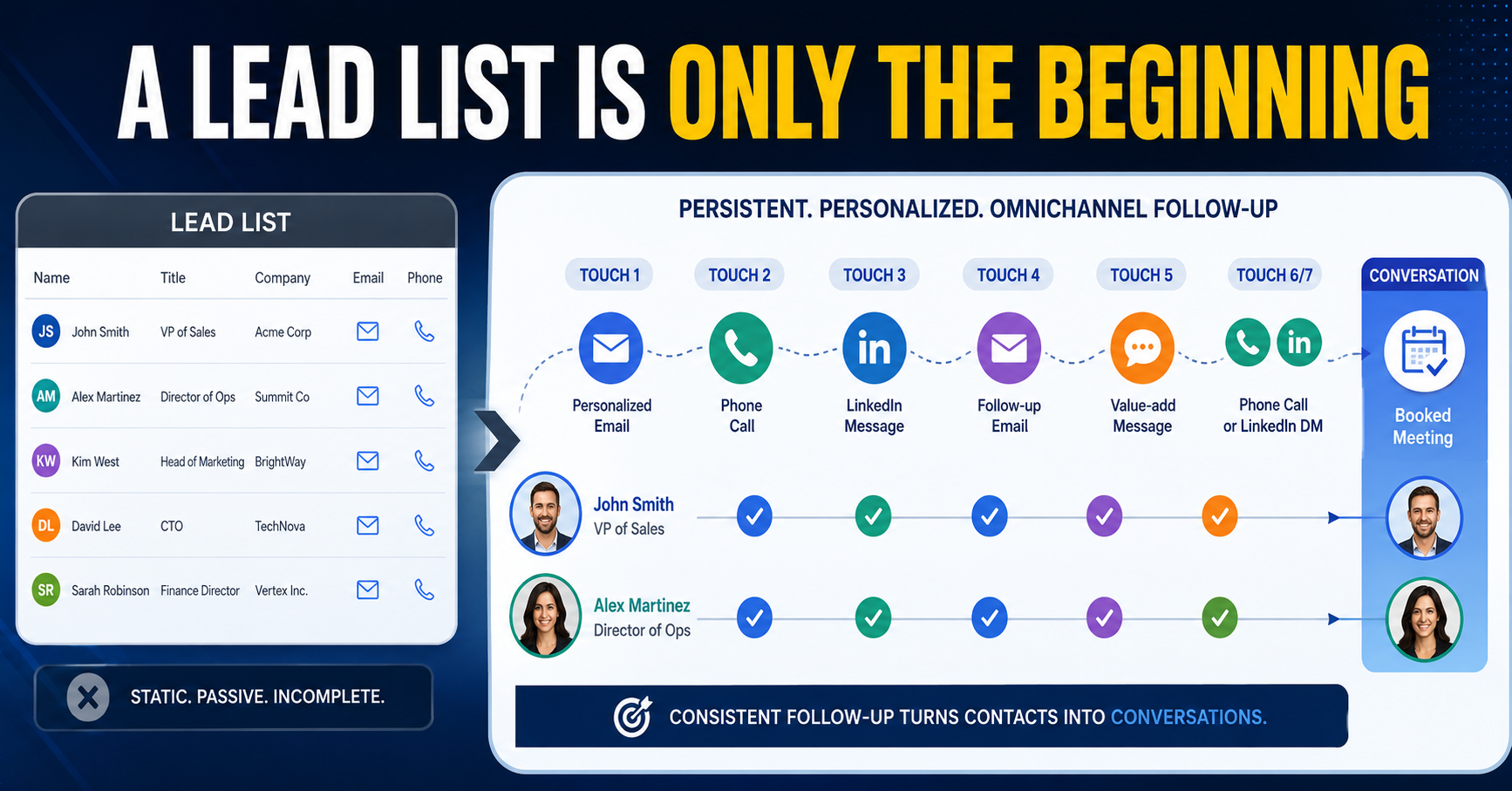
Outbound sales is not just a sequence of tasks. It is a sequence of judgments. Who is worth contacting? What matters to them? What message fits the moment? What detail is relevant? What tone works here? What should be said and what should be left unsaid? Those questions do not disappear just because the process is automated.
That is where the all-AI model starts to break.
Why Fully Automated Sales Development Falls Short
Fully automated sales development sounds efficient because it assumes the hard part is execution volume.
In reality, the hard part is getting the execution right.
This is where all-AI SDR models often disappoint. They can send messages, but sending messages is not the same as generating pipeline. They can create personalization, but that does not mean the personalization is useful. They can pull information, but that does not mean the information is accurate or meaningful.
A lot of AI-driven outbound ends up being polished nonsense. It looks personalized at first glance, but the relevance is weak. It references public information in obvious ways. It makes the same kinds of shallow compliments and predictable observations. It scales the appearance of thoughtfulness without actually doing the hard work of being thoughtful.
That is a problem because buyers can tell.
By 2026, most prospects have seen enough AI-generated outreach to spot it quickly. They know when a message has been stitched together from LinkedIn. They know when a sequence is pretending to be personal. They know when the sender is automating the idea of care instead of showing actual understanding.
That does not mean AI has no place in the process. It means automation is not a substitute for good outbound thinking.
The Data Problem Behind AI Prospecting
One of the biggest weaknesses in all-AI SDR models is the quality of the underlying prospecting logic.
AI can only work with what it sees. And in outbound sales, what it sees is often incomplete, outdated, misleading, or flat-out wrong.
This creates a real problem. AI agents often associate people with the wrong company. They misread job roles. They misunderstand context. They surface contacts who technically match a title but make no sense for the actual campaign. In some cases, they hallucinate or overstate relevance because the system is trying to connect dots that do not belong together.
That creates bad outreach.
If your AI tool thinks someone is a fit when they are not, the message starts from the wrong premise. If it pulls the wrong context, the personalization feels off. If it misunderstands who the buyer is or why they matter, the rep or workflow built on top of that data starts from a weak foundation.
This is one of the most overlooked reasons AI SDR tools underperform. The problem is not only the writing. It is the judgment behind who gets contacted, why they get contacted, and what assumptions shape the message.
AI can speed up bad logic just as easily as good logic.
Where AI Actually Helps Sales Teams
The failure of all-AI SDRs does not mean AI is useless. It means AI is most valuable when used as support rather than replacement.
This is where the Human-AI model becomes much stronger.
AI is genuinely useful for research. It can help sales teams understand accounts faster. It can summarize company information, surface useful context, organize notes, and accelerate preparation. It can help draft talking points. It can help build starting frameworks for email copy. It can help create individualized arguments for leads and accounts more efficiently than a fully manual process.
That is real value.
AI also helps with internal productivity. It can assist with proposal drafting, call preparation, account prioritization, and information synthesis. Used properly, it gives sales professionals more leverage. It reduces low-value administrative drag and frees up more time for real thinking and real conversations.
There may also be specific use cases where AI can support inbound follow-up, especially when a prospect has clearly opted in and is expecting communication. But that is very different from using AI to run fully automated outbound into a cold market. The first supports buyer intent. The second risks damaging trust before a real conversation ever starts.
But this only works when a human is still in control.
The AI can suggest. The human decides.
The AI can draft. The human checks.
The AI can surface research. The human interprets it.
The AI can speed up the process. The human makes sure the process still makes sense.
That is what turns AI from a gimmick into an advantage.
Why Human Judgment Still Matters
Sales is nuanced. That is the part many all-AI pitches tried to gloss over.
Prospects are not static data points. Markets are not uniform. Timing is not always obvious. Buyer motivations are rarely simple. The same outreach message that works well in one context can fail badly in another. Knowing the difference requires judgment.
Human judgment matters because sales development is not just about information. It is about interpretation.
A good sales professional can look at a prospect, a company, a market, and a campaign goal and ask the right questions. Does this account really make sense? Is this message too generic? Is the angle actually compelling? Are we reaching out too early? Are we following up too aggressively? Is this contact likely to care? Is this helping the brand or hurting it?
These are not minor details. They are the work.
This is also why “AI personalization” alone often does not convert. Personalization without judgment becomes decoration. It sounds tailored, but it is not strategic. Human professionals know how to turn insight into relevance. They know how to adjust tone. They know when to push and when to pause. They know when a message needs to be rewritten because it technically works but still feels wrong.
That is why sales remains a professional discipline, not just a software workflow.
Salaria’s Approach: Layers of AI, Not Full Automation
At Salaria, we believe in technology. We use it. We value it. But we do not believe in blind automation.
Our view is simple: AI should support the work. Humans should lead the sales strategy.
That means using layers of AI where AI actually helps. Research acceleration makes sense. Information organization makes sense. Draft support makes sense. Workflow assistance makes sense. Using AI to strengthen preparation and make reps more efficient makes sense.
What does not make sense is turning the entire outbound process over to machines and pretending that quality will take care of itself.
It will not.
Salaria’s model is built around human-led strategy, human-led execution, and human accountability, supported by the right level of AI. This is not because we are resistant to technology. It is because we are realistic about what creates results.
We have seen too many companies spend heavily on AI SDR tools that performed like a cheaper idea in theory but an expensive mistake in practice. In some cases, these tools can cost as much as human talent without delivering the same quality. In other cases, they are embraced because they improve agency margins, not because they improve client outcomes.
That is not how we think.
We use AI as a tool to make strong sales work better, not as an excuse to remove strong sales work from the process.
The Future Is Human-AI, Not Human Replacement
The future of sales development is not anti-AI. It is anti-fantasy.
The market has moved past the stage where “replace your SDR team with AI” sounds automatically credible. Companies have now seen enough to know that full automation is not the magic answer. AI can absolutely improve the sales process, but it works best when paired with people who know what they are doing.
That is the real lesson of 2026.
Human-AI teams are stronger because they combine speed with judgment, scale with context, and efficiency with accountability. They allow technology to do what technology does well while preserving the human skill that makes sales work in the first place.
That is the model Salaria believes in.
Not humans versus AI. Not humans replaced by AI. Humans, supported by AI, doing outbound the right way.
Because in the end, buyers are still human. Conversations are still human. Trust is still human. And the teams that understand that will keep outperforming the ones trying to automate it away.
Build a Smarter Human-AI Sales Development Model
If your team is questioning whether all-AI SDR tools are really delivering the pipeline they promised, you are not alone. The strongest outbound programs in 2026 are not fully automated. They are built around human expertise supported by the right use of AI.
Salaria helps B2B companies build sales development programs that combine strong research, real SDR execution, and smart AI support without sacrificing quality, judgment, or buyer trust.